The Matherati

Howard Gardner’s theory of multiple intelligences includes an intelligence he called Logical-Mathematical Intelligence, the ability to reason about numbers, shapes and structure, to think logically and abstractly.   In truth, there are several different capabilities in this broad category of intelligence – being good at pure mathematics does not necessarily make you good at abstraction, and vice versa, and so the set of great mathematicians and the set of great computer programmers, for example, are not identical.
But there is definitely a cast of mind we might call mathmind.   As well as the usual suspects, such as Euclid, Newton and Einstein, there are many others with this cast of mind.  For example, Thomas Harriott (c. 1560-1621), inventor of the less-than symbol, and the first person to draw the  moon with a telescope was one.   Newton’s friend, Nicolas Fatio de Duiller (1664-1753), was another.   In the talented 18th-century family of Charles Burney, whose relatives and children included musicians, dancers, artists, and writers (and an admiral), Charles’ grandson, Alexander d’Arblay (1794-1837), the son of writer Fanny Burney, was 10th wrangler in the Mathematics Tripos at Cambridge in 1818, and played chess to a high standard.  He was friends with Charles Babbage, also a student at Cambridge at the time, and a member of the Analytical Society which Babbage had co-founded; this was an attempt to modernize the teaching of pure mathematics in Britain by importing the rigor and notation of continental analysis, which d’Arblay had already encountered as a school student in France.
And there are people with mathmind right up to the present day.   The Guardian a year ago carried an obituary, written by a family member, of Joan Burchardt, who was described as follows:

My aunt, Joan Burchardt, who has died aged 91, had a full and interesting life as an aircraft engineer, a teacher of physics and maths, an amateur astronomer, goat farmer and volunteer for Oxfam. If you had heard her talking over the gate of her smallholding near Sherborne, Dorset, you might have thought she was a figure from the past. In fact, if she represented anything, it was the modern, independent-minded energy and intelligence of England. In her 80s she mastered the latest computer software coding.”

Since language and text have dominated modern Western culture these last few centuries, our culture’s histories are mostly written in words.   These histories favor the literate, who naturally tend to write about each other.    Clive James’ book of a lifetime’s reading and thinking, Cultural Amnesia (2007), for instance, lists just 1 musician and 1 film-maker in his 126 profiles, and includes not a single mathematician or scientist.     It is testimony to text’s continuing dominance in our culture, despite our society’s deep-seated, long-standing reliance on sophisticated technology and engineering, that we do not celebrate more the matherati.
On this page you will find an index to Vukutu posts about the Matherati.
FOOTNOTE: The image above shows the equivalence classes of directed homotopy (or, dihomotopy) paths in 2-dimensional spaces with two holes (shown as the black and white boxes). The two diagrams model situations where there are two alternative courses of action (eg, two possible directions) represented respectively by the horizontal and vertical axes.  The paths on each diagram correspond to different choices of interleaving of these two types of actions.  The word directed is used because actions happen in sequence, represented by movement from the lower left of each diagram to the upper right.  The word homotopy refers to paths which can be smoothly deformed into one another without crossing one of the holes.  The upper diagram shows there are just two classes of dihomotopically-equivalent paths from lower-left to upper-right, while the lower diagram (where the holes are positioned differently) has three such dihomotopic equivalence classes.  Of course, depending on the precise definitions of action combinations, the upper diagram may in fact reveal four equivalence classes, if paths that first skirt above the black hole and then beneath the white one (or vice versa) are permitted.  Applications of these ideas occur in concurrency theory in computer science and in theoretical physics.

AI's first millenium: prepare to celebrate

A search algorithm is a computational procedure (an algorithm) for finding a particular object or objects in a larger collection of objects. Typically, these algorithms search for objects with desired properties whose identities are otherwise not yet known.   Search algorithms (and search generally) has been an integral part of artificial intelligence and computer science this last half-century, since the first working AI program, designed to play checkers, was written in 1951-2 by Christopher Strachey. At each round, that program evaluated the alternative board positions that resulted from potential next moves, thereby searching for the “best” next move for that round.

The first search algorithm in modern times apparently dates from 1895:  a depth-first search algorithm to solve a maze, due to amateur French mathematician Gaston Tarry (1843-1913).  Now, in a recent paper by logician Wilfrid Hodges, the date for the first search algorithm has been pushed back much further: to the third decade of the second millenium, the 1020s, a thousand years ago. Hodges translates and analyzes a logic text of Persian Islamic philosopher and mathematician, Ibn Sina (aka Avicenna, c. 980 – 1037) on methods for finding a proof of a syllogistic claim when some premises of the syllogism are missing.

Representation of domain knowledge using formal logic and automated reasoning over these logical representations (ie, logic programming) has become a key way in which intelligence is inserted into modern machines; searching for proofs of claims (“potential theorems”) is how such intelligent machines determine what they know or can deduce. It is nice to think that automated theorem-proving is almost 990 years old.

References:

B. Jack Copeland [2000]:  What is Artificial Intelligence?

Wilfrid Hodges [2010]: Ibn Sina on analysis: 1. Proof search. or: abstract state machines as a tool for history of logic.  pp. 354-404, in: A. Blass, N. Dershowitz and W. Reisig (Editors):  Fields of Logic and Computation. Lecture Notes in Computer Science, volume 6300.  Berlin, Germany:  Springer.   A version of the paper is available from Hodges’ website, here.

Gaston Tarry [1895]: La problem des labyrinths. Nouvelles Annales de Mathématiques, 14: 187-190.

In defence of futures thinking

Norm at Normblog has a post defending theology as a legitimate area of academic inquiry, after an attack on theology by Oliver Kamm.  (Since OK’s post is behind a paywall, I have not read it, so my comments here may be awry with respect to that post.)  Norm argues, very correctly, that it is legitimate for theology, considered as a branch of philosophy to, inter alia, reflect on the properties of entities whose existence has not yet been proven.  In strong support of Norm, let me add:  Not just in philosophy!

In business strategy, good decision-making requires consideration of the consequences of potential actions, which in turn requires the consideration of the potential actions of other actors and stakeholders in response to the first set of actions.  These actors may include entities whose existence is not yet known or even suspected, for example, future competitors to a product whose launch creates a new product category.   Why, there’s even a whole branch of strategy analysis, devoted to scenario planning, a discipline that began in the military analysis of alternative post-nuclear worlds, and whose very essence involves the creation of imagined futures (for forecasting and prognosis) and/or imagined pasts (for diagnosis and analysis).   Every good air-crash investigation, medical diagnosis, and police homicide investigation, for instance, involves the creation of imagined alternative pasts, and often the creation of imaginary entities in those imagined pasts, whose fictional attributes we may explore at length.   Arguably, in one widespread view of the philosophy of mathematics, pure mathematicians do nothing but explore the attributes of entities without material existence.

And not just in business, medicine, the military, and the professions. In computer software engineering, no new software system development is complete without due and rigorous consideration of the likely actions of users or other actors with and on the system, for example. Users and actors here include those who are the intended target users of the system, as well as malevolent or whimsical or poorly-behaved or bug-ridden others, both human and virtual, not all of whom may even exist when the system is first developed or put into production. If creative articulation and manipulation of imaginary futures (possible or impossible) is to be outlawed, not only would we have no literary fiction or much poetry, we’d also have few working software systems either.

Hand-mind-eye co-ordination

Last month, I posted some statements by John Berger on drawing.  Some of these statements are profound:

A drawing of a tree shows, not a tree, but a tree-being-looked-at.  . . .  Within the instant of the sight of a tree is established a life-experience.” (page 71)

Berger asserts that we do not draw the objects our eyes seem to look at.  Rather, we draw some representation, processed through our mind and through our drawing arm and hand, of that which our minds have seen.  And that which our mind has seen is itself a representation (created by mental processing that includes processing by our visual processing apparatus) of what our eyes have seen.    Neurologist Oliver  Sacks, writing about a blind man who had his sight restored and was unable to understand what he saw, has written movingly about the sophisticated visual processing skills involved in even the simplest acts of seeing, skills which most of us learn as young children (Sacks 1993).

So a drawing of a tree is certainly not itself a tree, and not even a direct, two-dimensional representation of a tree, but a two-dimensional hand-processed manifestation of a visually-processed mental manifestation of a tree.   Indeed, perhaps not even always this, as Marion Milner has reminded us:    A drawing of a tree is in fact a two-dimensional representation of the process of manifesting through hand-drawing a mental representation of a tree.  Is it any wonder, then, that painted trees may look as distinctive and awe-inspiring as those of Caspar David Friedrich (shown above) or Katie Allen?

As it happens, we still know very little, scientifically, about the internal mental representations that our minds have of our bodies.  Recent research, by Matthew Longo and Patrick Hazzard, suggests that, on average, our mental representations of our own hands are inaccurate.   It would be interesting to see if the same distortions are true of people whose work or avocation requires them to finely-control their hand movements:  for example, jewellers, string players, pianists, guitarists, surgeons, snooker-players.   Do virtuoso trumpeters, capable of double-, triple- or even quadruple-tonguing, have sophisticated mental representations of their tongues?  Do crippled artists who learn to paint holding a brush with their toes or in their mouth acquire sophisticated and more-accurate mental representations of these organs, too?  I would expect so.

These thoughts come to mind as I try to imitate the sound of a baroque violin bow by holding a modern bow higher up the bow.   By thus changing the position of my hand, my playing changes dramatically, along with my sense of control or power over the bow, as well as the sounds it produces.

Related posts here, here and here.

References:

John Berger [2005]:  Berger on Drawing.  Edited by Jim Savage.  Aghabullogue, Co. Cork, Eire:  Occasional Press.  Second Edition, 2007.

Matthew Longo and Patrick Haggard [2010]: An implicit body representation underlying human position sense. Proceedings of the National Academy of Sciences, USA, 107: 11727-11732.  Available here.

Marion Milner (Joanna Field) [1950]: On Not Being Able to Paint. London, UK:  William Heinemann.  Second edition, 1957.

Oliver Sacks[1993]:  To see and not seeThe New Yorker, 10 May 1993.

Varese and Overton

Previously, I’ve mentioned jazz pianist, teacher and composer Hall Overton, here and here.  I’ve just come across non-released recordings of free-jazz workshops organized and conducted by pioneer classical composer Edgar Varese in New York in 1957, in which Overton plays piano (and a guy named Mingus plays bass).   Varese’s influence continues:  a few years ago a concert of some of his music along with contemporary and club-based electronica completely pre-sold-out the 2380-seat capacity of Liverpool’s Royal Philharmonic Hall.

The long after-life of design decisions

Reading Natasha Vargas-Cooper’s lively romp through the 1960s culture referenced in the TV series Mad Men, I came across Tim Siedell’s discussion of a witty, early 1960s advert by Doyle Dane Bernbach for Western Union telegrams, displayed here

Seeing a telegram for the first time in about, oh, 35 years*, I looked at the structure.   Note the header, with information about the company, as well as meta-information about the message.   That structure immediately brought to mind the structure of a TCP packet.

The Transmission Control Protocol (TCP) is the work-horse protocol of the Internet, and was developed by Vince Cerf and Bob Kahn in 1974.   Their division of the packet contents into a header-part (the control information) and a data part (the payload) no doubt derived from earlier work on the design of packets for packet-switched networks.   Later packets (eg, for IP, the Internet Protocol) were simpler, but still retained this two-part structure.  This two-part division is also found in voice telecommunications at the time, for example in Common Channel Signalling Systems, which separated message content from information about the message (control information).   Such systems were adopted internationally by the ITU for voice communications from Signalling System #6 (SS6) in 1975 onwards.  In case the packet design seems obvious, it is worth considering some alternatives:  the meta-information could be in a footer rather than in a header, or enmeshed in the data itself (as, for example, HTML tags are enmeshed in the content they modify).  Or, the meta-data could be sent in a separate packet, perhaps ahead of the data packet, as happens with control information in Signalling System #7 (SS7), adopted from 1980.  There are technical reasons why some of these design possibilities are not feasible or not elegant, and perhaps the same reasons apply to transmission of telegrams (which is, after all, a communications medium using packets).
The first commercial electrical telegraph networks date from 1837, and the Western Union company itself dates from 1855 (although created from the merger of earlier companies).  I don’t know when the two-part structure for telegrams was adopted, but it was certainly long before Vannevar Bush predicted the Internet in 1945, and long before packet-switched communications networks were first conceived in the early 1960s.   It is interesting that the two-part structure of the telegramlives on in the structure of internet packets.
* Footnote: As I recall, I sent my first email in 1979.
Reference:
Tim Siedell [2010]: “Western Union:  What makes a great ad?” pp. 15-17 of:  Natasha Vargas-Cooper [2010]:  Mad Men Unbuttoned. New York, NY:  HarperCollins.

As we once thought


The Internet, the World-Wide-Web and hypertext were all forecast by Vannevar Bush, in a July 1945 article for The Atlantic, entitled  As We May Think.  Perhaps this is not completely surprising since Bush had a strong influence on WW II and post-war military-industrial technology policy, as Director of the US Government Office of Scientific Research and Development.  Because of his influence, his forecasts may to some extent have been self-fulfilling.
However, his article also predicted automated machine reasoning using both logic programming, the computational use of formal logic, and computational argumentation, the formal representation and manipulation of arguments.  These areas are both now important domains of AI and computer science which developed first in Europe and which still much stronger there than in the USA.   An excerpt:

The scientist, however, is not the only person who manipulates data and examines the world about him by the use of logical processes, although he sometimes preserves this appearance by adopting into the fold anyone who becomes logical, much in the manner in which a British labor leader is elevated to knighthood. Whenever logical processes of thought are employed—that is, whenever thought for a time runs along an accepted groove—there is an opportunity for the machine. Formal logic used to be a keen instrument in the hands of the teacher in his trying of students’ souls. It is readily possible to construct a machine which will manipulate premises in accordance with formal logic, simply by the clever use of relay circuits. Put a set of premises into such a device and turn the crank, and it will readily pass out conclusion after conclusion, all in accordance with logical law, and with no more slips than would be expected of a keyboard adding machine.
Logic can become enormously difficult, and it would undoubtedly be well to produce more assurance in its use. The machines for higher analysis have usually been equation solvers. Ideas are beginning to appear for equation transformers, which will rearrange the relationship expressed by an equation in accordance with strict and rather advanced logic. Progress is inhibited by the exceedingly crude way in which mathematicians express their relationships. They employ a symbolism which grew like Topsy and has little consistency; a strange fact in that most logical field.
A new symbolism, probably positional, must apparently precede the reduction of mathematical transformations to machine processes. Then, on beyond the strict logic of the mathematician, lies the application of logic in everyday affairs. We may some day click off arguments on a machine with the same assurance that we now enter sales on a cash register. But the machine of logic will not look like a cash register, even of the streamlined model.”

Edinburgh sociologist, Donald MacKenzie, wrote a nice history and sociology of logic programming and the use of logic of computer science, Mechanizing Proof: Computing, Risk, and Trust.  The only flaw of this fascinating book is an apparent misunderstanding throughout that theorem-proving by machines  refers only to proving (or not) of theorems in mathematics.    Rather, theorem-proving in AI refers to proving claims in any domain of knowledge represented by a formal, logical language.    Medical expert systems, for example, may use theorem-proving techniques to infer the presence of a particular disease in a patient; the claims being proved (or not) are theorems of the formal language representing the domain, not necessarily mathematical theorems.
References:
Donald MacKenzie [2001]:  Mechanizing Proof: Computing, Risk, and Trust (2001).  Cambridge, MA, USA:  MIT Press.
Vannevar Bush[1945]:  As we may thinkThe Atlantic, July 1945.

Recent listening 4: Caravan


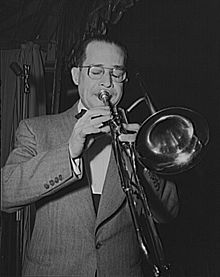
One of life’s pleasures is listening to John Schaefer’s superb radio program on WNYC, New Sounds from New York.  I have just heard his recent program presenting different versions of the jazz standard, Caravan. The song is associated with Duke Ellington, although it was composed by trombonist Juan Tizol (pictured playing a valve trombone), and the words were by Irving Mills.   Some of these versions I knew and like, particularly the ambient versions of trumpeter John Hassell (minutes 7:17 and 43:38 of the album):

  • Jon Hassell:  Fascinoma. Water Lily Acoustics, 1999.

The program also included a superb ska version which I did not know before, by the band Hepcat, here.

  • Hepcat:  Out of Nowhere. Hellcat, 2004.   (Reissue of Moon Ska Records, 1983).

One great version not on the program is an arrangement by Gordon Jenkins. This has an agitated string accompaniment, a walking treble sounding like bees circling the soloist, and was included in Season 1 of Mad Men.  Someone has posted a recording on Youtube here.

  • Mad Men:  Music from the Series, volume 1. Lionsgate, 2008.

A superb live version I once heard by a violin-and-guitar band in Brisbane I have written about here.

Two other great ambient albums are:

  • Bill Laswell and Remix Productions:  Bob Marley Dreams of Freedom. Ambient Translations of Bob Marley in Dub. Island Records, 1997.
  • Ethiopiques, Volume 4.  Ethio Jazz and Musique Instrumental 1969-1974. Buda Musique.  This volume comprises performances and arrangements by Ethiopian jazz keyboardist, Mulatu Astatke, on albums first issued in Ethiopia in 1972 and 1974.

Posts in this series are here.

Postscript (2024-03-12): An exciting live performance of Caravan led by blind pianist Oleg Akkuratov at the 2021 Summer Evenings in Yelabuga Festival in Tatarstan is here. (Hat Tip: AD, who was there.)

Postscript (2024-04-18): Another exceptionally good and sublime version is by button accordianist Aydar Salakhov, double bassist Dima Tarbeev, and percussionist Dmitry Mezhenin, on Instagram here.

Postscript (2024-05-28):And here is an encore I heard live by pianist (and bongos player) Frank Dupree with members of the Philharmonia Orchestra in the Royal Festival Hall in London on Thursday 7 March 2024.

Those pesky addition symbols

On 28 March 1979, there was a partial core meltdown in a reactor at the Three Mile Island Nuclear Power Generating Station near Harrisburg, PA, USA.  The accident was soon headline news, at least throughout the western world.   An obscure computer programmer apparently hearing this news had a crisis of conscience and, in April 1979, phoned anonymously to the US Nuclear Regulatory Commission, telling them to examine particular program code used in the design of certain types of nuclear reactors.   The code in question was a subroutine intended to calculate the total stresses on pipes carrying coolant water, but instead of adding the different stresses, the routine subtracted them.  So the resulting coolant pipes were extra-thin instead of being extra-thick.

This story would not surprise anyone with any software development experience.   Few other people understand, I think, just how dependent modern society is on the correct placing of mundane arithmetic operators or the appropriate invocation of variable references in obscure lines of old program code.  No programmers, in my experience, took less than seriously, for example, the threat of the Millenium Bug, although lots of people who are not programmers still think it was a threat without substance, or even a scam.

Below I have re-typed the article where first I read about this, as I can find no reference elsewhere on the web.

Faulty software may close more nuclear plants
(from Australasian Computerworld, 18 May 1979, pages 1 and 15).

Washington, DC. – The Nuclear Regulatory Commission (NRC) in the US may soon order more shutdowns of nuclear plants if it finds the design of their piping relies on invalid computer algorithms.

The commission is completing a study [page-break] to determine whether earthquakes could rupture the computer-designed piping of active US nuclear plants as well as those under construction.  In March, the commission ordered five plants in the eastern US to cease operation after an error was discovered in their design software.

The study was initiated following an anonymous phone call last month from an individual who reportedly told the NRC that many other plants were designed or are being designed with similarly flawed routines.  As a result, the commission ordered all 70 licensed plants and the 92 granted construction permits to declare whether they rely on any of three algebraic summation methods.

The water to cool reactor cores in the five suspended plants ran through pipes with tolerances far below NRC standards because of an algebraic summation routine subtracted, rather than added, stress figures.
Nuclear energy experts consider reliable reactor piping a critical safety factor.  A reactor core overheats if not enough water circulates around its radioactive rods to carry heat away.  Pipe ruptures or pump failures would thus induce core overheating that, if unchecked by reserve cooling systems, might force the reactor to discharge dangerous radiation.

NRC inspectors may order more shutdowns if they find other plants in violation of piping tolerance requirements, a spokesman said.  Their decisions will be based on responses to a general bulletin to holders of licences and construction permits.

Need God be complex?


Philosopher Gary Gutting attacks the logic of the argument of Richard Dawkins for atheism, here.   Gutting formulates Dawkins’ main argument for atheism as the following chain of reasoning:

1. There is need for an explanation of the apparent design of the universe.
2. The universe is highly complex.
3. An intelligent designer of the universe would be even more highly complex.
4. A complex designer would itself require an explanation.
5. Therefore, an intelligent designer will not provide an explanation of the universe’s complexity.
6. On the other hand, the (individually) simple processes of natural selection can explain the apparent design of the universe.
7. Therefore, an intelligent designer (God) almost certainly does not exist.”

Gutting argues that Claim #7 does not following from Propositions #1 through #6.  But this stated chain of reasoning falls well before reaching claim #7.  Claim #3 does not follow from Claims #1 and #2.    Complex phenomena may emerge from simpler components, as is seen (for example) in the apparently-coordinated, but actually-uncoordinated, behaviours of insects and (simple-rule-following, non-communicating) swarm robots, or in the patterns that emerge in some cellular automata, as in John Conway’s Game of Life.  One could easily imagine a creator who established some simple ground-rules (eg, the laws of thermodynamics and the rules of biological evolution) and a starting position for the universe (eg, the Big Bang), and just let the process evolve or adapt over the course of time, without further divine intervention, subject only to the given rules.  Such a creator need not, Him-, Her- or It-self, be very complex at all, and certainly could be less complex than the universe that resulted in the fullness of time.
This phenomenon is known to most software engineers working on large systems, writing software that exhibits behaviours more complex than they are able to explain or understand subsequently, and even more complex than they intended to create.  The recent Flash Crash of stock prices on 6 May 2010 may be the result of such emergent complexity, unintended (and as yet unexplained) by the system designers, programmers and financial market regulators who operate the world’s stock markets.   Even common computer operating systems are beyond the ability of one person to entirely comprehend, let alone design:  Windows XP has an estimated 40 million source lines of code (SLOC), for example, while Debian 4.0 has an estimated 283 million SLOC.   These are among the most complex human artefacts yet created.  Indeed, the phenomenon is so prevalent in software development that the British Government sponsored research into the topic (see, for example, Bullock and Cliff  2004).
It also seems to me that Claim #4 needs some justification, since it is not obviously true.   Most scientists, for instance, seem perfectly happy accepting certain claims as not requiring any explanation or even any inquiry.  These claims differ from one discipline to another, and typically change over time.  Moreover, uncontested claims in one discipline often form the basis, when contested, of another discipline:  marketing, for example, starts from the contestation of  the foundational notions of commodities, of perfect competition, and of infinite consumer mental processing capabilities that remain uncontested (at least until recently) in mainstream economics; computer science, in another example, contests the assumption of the existence of non-constructive entities taken for granted in mainstream (non-intuitionistic) pure mathematics; parts of the study of uncertainty in artificial intelligence contest the Law of Excluded Middle taken for granted in probability theory and in mathematical statistics.
Gutting also criticises Dawkins for the lack of sophistication of his philosophical arguments:

Religious believers often accuse argumentative atheists such as Dawkins of being excessively rationalistic, demanding standards of logical and evidential rigor that aren’t appropriate in matters of faith. My criticism is just the opposite. Dawkins does not meet the standards of rationality that a topic as important as religion requires.
The basic problem is that meeting such standards requires coming to terms with the best available analyses and arguments. This need not mean being capable of contributing to the cutting-edge discussions of contemporary philosophers, but it does require following these discussions and applying them to one’s own intellectual problems. Dawkins simply does not do this. He rightly criticizes religious critics of evolution for not being adequately informed about the science they are calling into question. But the same criticism applies to his own treatment of philosophical issues.”

I am reminded of Terry Eagleton’s criticism that Dawkins had read insufficient theology, in this spirited review of Dawkins’ book.  Eagleton begins:

Imagine someone holding forth on biology whose only knowledge of the subject is the Book of British Birds, and you have a rough idea of what it feels like to read Richard Dawkins on theology.

Finally, Gutting repeats something mentioned before on this blog:

There are sensible people who report having had some kind of direct awareness of a divine being . . “

If we broadened this group of people to “sensible people who report some kind of direct awareness of non-material realms and divine entities”, then, inter alia, the majority of African, Indian and Chinese people and the first peoples of North America and Australia would fall in this category.
References:
Seth Bullock and Dave Cliff [2004]: Complexity and Emergent Behaviour in Information and Communications Systems.  Report for the UK Foresight Programme on Intelligent Infrastructure Systems, Office of Science and Technology, Government of the UK.  Available here.   Programme Information here.
Richard Dawkins [2006]: The God Delusion.  Bantam Press.
Terry Eagleton [2006]: Lunging, flailing, mispunching.   London Review of Books, 28 (20):  32-34.  2006-10-19.
Gary Gutting [2010]:  On Dawkins’s atheism:  a responseNew York Times, 2010-08-11.