Caravan in Brisbane

While posting about great jazz gigs, I remembered one superb performance I’d forgotten to record.   On 27 November 2009, I heard a gypsy-style jazz group play at Brisbane Jazz Club.  The Club has a million-dollar location at Kangaroo Point on the Brisbane River, looking back towards the city. Watching performers against a large window showing a darkening city skyscape across the water was just magical. I hope that the club can recover from the recent floods and return to their home.

The audience that night was about 50, including tables of people speaking Japanese and Russian.  The band was advertised as Cam Ford’s Gypsy Swingers, but I’m not sure everyone was there.  The line-up included  Ian Date, leader, on acoustic guitar and trumpet, his brother Nigel Date on acoustic guitar, Daniel Weltlinger on violin, and two players whose names I failed to catch – an acoustic guitarist and an electric bass player.    Later in the evening, the five were joined by another acoustic guitarist and a clarinet player (Dan?).  The music included some flamenco (to be expected with all those guitars) and was mostly 1920s Hot Club de France-style arrangements.    Most pieces had a fast, 4/4 tradjazz beat, with the bass playing a walking bass part.    This is a style of jazz I am not fond of, since much of it sounds the same, but the players showed real skill.   The violin or the lead guitar usually played a solo over the top, or sometimes, the two – violin and lead guitar – played a call-and-response duet.    These tunes were all done with energy, enthusiasm and skill.
With the full line-up of seven, the group played an absolutely superb arrangement of Caravan, a song I have blogged about before.  The arrangement began with the violin playing the melody over guitar rhythms and an ostinato bass.    This first run through was then followed by several choruses where the melody was played  in unison first by the violin and one guitar, and then with a second guitar playing a 2nd or a 3rd higher than the unison part.  The effect of this was something like an Hawaiiwan guitar, and created a sound that was iridescent, shimmering like the flickering lights on the river in the window behind the musicians.
To me, the stand-out  performer on the night was the violinist, Daniel Weltlinger, whom nothing seemed to faze.  At one point, when the two additional players joined, he was shouting chord changes to the clarinetist while improvising his own solo at the same time.

Bam and sweet potato pie

Here’s a story from Barack Obama’s 2008 Presidential campaign which I meant to blog when I read it.   From an article by Mark Danner:

Everything else they [election commentators and bloggers] would never see. It existed only for the several thousand cheering people in Vernon Park on that bright morning in Germantown. They would never see, for instance, Obama’s riff on sweet potato pie. It came as he told a story about his campaigning “the other day in a little town in Ohio, with the governor there,” about how he and the governor suddenly felt hungry and “decided we’d stop right there and get some pie.” Now here began a little gem of a story, which had at its center the diner employees who wanted to take a picture with Obama, not least because, as they told him, their boss was a die-hard Republican and “they wanted to tweak him a little with that picture.” All this was heading toward a carefully choreographed finale, where the owner appeared personally with the pie for candidate and governor and Obama looked at the pie and looked at the pie-carrying die-hard Republican owner and “then I said to him”—perfectly elongated pause—“How’s business?”
This brought on great gales of laughter from the crowd. For the joke turned on a point already precisely made: How can even the most die-hard of die-hard Republicans, if he is thinking of his self-interest, how can he vote Republican this year? “If you beat your head against the wall,” Obama demanded of that faraway Republican with his pie, to a blizzard of “oh yeahs!” and “you got that right!” from the crowd, “and it hurts and hurts, how can you keep doing it?” But it was those two words, ”How’s business?”—that casual greeting thrown at the Republican diner owner that showed that there simply could be no other choice this year—that showed the case proved, wrapped up, unassailable.

And yet what struck me in this little model of political art was a tiny riff the candidate effortlessly worked into it from his banter with the crowd. When Obama launched into his story with “Because I love pie,” a woman out in that sea of cheering, laughing people shouted back, “I’ll make you pie, baby!” and to the general hooting laughter the candidate returned, “Oh yeah, you gonna make me pie?” Then, after a beat, amid even more raucous laughter, and several other female voices shouting out invitations, “You gonna make me sweet potato pie?” More shouts and laughter. “All you gonna make me pie?”
“Well you know I love sweet potato pie. And I think what we’re going to have to do here”—and the laughter and the shouting rose and as it did his voice rose above it—“what we’re going to have to do here is have a sweet potato pie contest…. That’s right. And in this contest, I’m gonna be the judge.” The laughter rose and you could hear not only the women but the deep laughter of the men taking delight in the double entendre that was not only about the women and their laughing, teasing offers and about their pie that that lanky confident smiling young man knew how to eat and enjoy and judge, but even more now, amazingly, as people came one by one to recognize, about something else. To those people gathered in Vernon Park that bright sun-drenched morning, it was an even more titillating and more pleasurable double entendre, for it was most clearly about something they’d never had but hoped and dreamed of having and now had begun to believe they were within the shortest of short distances of finally tasting. “Because you all know,” their candidate told them, “that I know sweet potato pie.” “

Reference:
Mark Danner [2008]:  Obama and Sweet Potato PieNew York Review of Books, 23 October 2008.

Scottish Marley Chingus

A quick shout-out to Marley Chingus Jazz Explosion, who play at The Caledonia alternate Friday nights, to where a friend invited me last night.  In truth, I’ve seen their posters for a couple of years, but had avoided going to hear them.  Their twee name makes them sound like a tribute band, and who wants to listen to people with insufficient imagination to play their own music, or even to invent their own name?
But the loss was mine.  What a great performance!  The quartet comprises Colin Lamont on drums, Dave Spencer on e-double bass, Bob Whittaker on tenor, and long-fingered medic Misha Gray on e-piano.    Last night they also had guesting another tenor player, whose name I did not catch.  (And Principal Cellist of the RLPO, Jonathan Aasgaard, was also in the crowd.)  Mingus, Monk, and Shorter featured (eg, JuJu), as well as their own fine compositions in brazen, hard-driving, funky, modal post-bop – serious early-60s jazz, before the harmonic emptiness of fusion took prominence.   What I particularly liked was that their solos did not sound the same from song to song; quite a few jazz performers really play the same solos whatever the underlying tune.   Gray’s trills, two-finger glissandos, and left-hand ostinatos were a delight, recalling early piano styles, and I also liked his occasional Shearing-style block chords.  He could do more with those, I think.
Pity about the name, though.

The otherness of the other

In previous posts (eg, here and here), I have talked about the difficulty of assessing the intentions of others, whether for marketing or for computer network design or for national security. The standard English phrase speaks of “putting ourselves in the other person’s shoes”.  But this is usually not sufficient:  we have to put them into their shoes, with their beliefs, their history, their desires, and their constraints, not ourselves, in order to understand their goals and intentions, and to anticipate their likely strategies and actions.    In a fine political thriller by Henry Porter, I come across this statement (page 220):

‘Motive is always difficult to read,’ he replied.  ‘We make a rational assumption about someone’s behaviour based on what we would, or would not, do in the same circumstances, ignoring the otherness of the other. We consider only influences that make us what we are and impose those beliefs on them.  It is the classic mistake of intelligence analysis.’  “

Reference:
Henry Porter [2009]: The Dying Light. London, UK:  Orion Books.
Obscure fact:  Porter (born 1953) is the grand-nephew of novelist Howard Sturgis (1855-1920), step-cousin to George Santayana (1863-1952).

On Getting Things Done

New York Times Op-Ed writer, David Brooks, has two superb articles about the skills needed to be a success in contemporary technological society, the skills I refer to as Getting-Things-Done IntelligenceOne is a short article in The New York Times (2011-01-17), reacting to the common, but wrong-headed, view that technical skill is all you need for success, and the other a long, fictional disquisition in The New Yorker (2011-01-17) on the social skills of successful people.  From the NYT article:

Practicing a piece of music for four hours requires focused attention, but it is nowhere near as cognitively demanding as a sleepover with 14-year-old girls. Managing status rivalries, negotiating group dynamics, understanding social norms, navigating the distinction between self and group — these and other social tests impose cognitive demands that blow away any intense tutoring session or a class at Yale.

Yet mastering these arduous skills is at the very essence of achievement. Most people work in groups. We do this because groups are much more efficient at solving problems than individuals (swimmers are often motivated to have their best times as part of relay teams, not in individual events). Moreover, the performance of a group does not correlate well with the average I.Q. of the group or even with the I.Q.’s of the smartest members.
Researchers at the Massachusetts Institute of Technology and Carnegie Mellon have found that groups have a high collective intelligence when members of a group are good at reading each others’ emotions — when they take turns speaking, when the inputs from each member are managed fluidly, when they detect each others’ inclinations and strengths.

Participating in a well-functioning group is really hard. It requires the ability to trust people outside your kinship circle, read intonations and moods, understand how the psychological pieces each person brings to the room can and cannot fit together.

This skill set is not taught formally, but it is imparted through arduous experiences. These are exactly the kinds of difficult experiences Chua shelters her children from by making them rush home to hit the homework table.”

These articles led me to ask exactly what is involved in reading a social situation?  Brooks mentions some of the relevant aspects, but not all.   To be effective, a manager needs to parse the social situation of the groups he or she must work with – those under, those over and peer groups to the side – to answer questions such as the following:

  • Who has power or influence over each group?  Is this exercised formally or informally?
  • What are the norms and practices of the group, both explicit and implicit, known and unconscious?
  • Who in the group is reliable as a witness?   Whose stories can be believed?
  • Who has agendas and what are these?
  • Who in the group is competent or capable or intelligent?  Whose promises to act can be relied upon?  Who, in contrast, needs to be monitored or managed closely?
  • What constraints does the group or its members operate under?  Can these be removed or side-stepped?
  • What motivates the members of the group?  Can or should these motivations be changed, or enhanced?
  • Who is open to new ideas, to change, to improvements?
  • What obstacles and objections will arise in response to proposals for change?  Who will raise these?  Will these objections be explicit or hidden?
  • Who will resist or oppose change?  In what ways? Who will exercise pocket vetos?

Parsing new social situations – ie, answering these questions in a specific situation – is not something done in a few moments.  It may take years of observation and participation to understand a new group in which one is an outsider.  People who are good at this may be able to parse the key features of a new social landscape within a few weeks or months, depending on the level of access they have, and the willingness of the group members to trust them.     Good management consultants, provided their sponsors are sufficiently senior, can often achieve an understanding within a few weeks.   Experience helps.

Needless to say, most academic research is pretty useless for these types of questions.  Management theory has either embarked on the reduce-and-quantify-and-replicate model of academic psychology, or else undertaken the narrative descriptions of successful organizations of most books by business gurus.   Narrative descriptions of failures would be far more useful.

The best training for being able to answer such questions – apart from experience of life – is the study of anthropology or literature:  Anthropology because it explores the social structures of other cultures and the factors within a single lifetime which influence these structures, and Literature because it explores the motivations and consequences of human actions and interactions.   The golden age of television drama we are currently fortunate to be witness to also provides good training for viewers in human motivations, actions and interactions.  It is no coincidence, in my view, that the British Empire was created and run by people mostly trained in Classics, with its twofold combination of the study of alien cultures and literatures, together with the analytical rigor and intellectual discipline acquired through the incremental learning of those difficult subjects, Latin and Ancient Greek languages.

UPDATE (2011-02-16): From Norm Scheiber’s profile of US Treasury Secretary Timothy Geithner in The New Republic (2011-02-10):

“Tim’s real strength … is that he’s really quick at reading the culture of any institutions,” says Leslie Lipschitz, a former Geithner deputy.

The profile also makes evident Geithner’s agonistic planning approach to policy – seeking to incorporate opposition and minority views into both policy formation processes and the resulting policies.
Monty under Howard Hawks

From an article by David Bromwich about the movies of Howard Hawks:

The best actors of Hollywood films for three decades did a lot of their best work with Hawks.  Grant and Bogart, pre-eminently, but also Cagney, Edward G Robinson, Hepburn (whom he introduced to screwball comedy), Barbara Stanwyck in Ball of Fire, Carole Lombard (who first showed her formidable power and comic range in Twentieth Century), and Montgomery Clift – a refined actor on the brink of being dismissed as overdelicate when Hawks gave him the second lead in Red River and offered tips on movement and gesture.  For example, “the business”, as Hawks’s biographer Todd McCarthy relates, “of putting a strand of wheat in his mouth”; also “rubbing the side of his nose while in thought”.  All the dynamic contest of that movie is there in the contrast between the voices of John Wayne and Clift, the loud monotone of command and the distinct but quiet utterance that suggests a reserve of conscience.  All this Hawks must have heard at once and measured against the story when he saw the actors read for their parts.” (page 17, The Guardian Review, 2011-01-15)

It is hard to believe that someone who had been the leading male actor on the New York stage for a decade before he made his first film should have needed tips on movement and gesture, even from someone as great as Howard Hawks.  Once again, Monty’s intelligence, contribution and agency seem belittled and minimized. Why is this, I wonder?
And, while we are wondering about his reception, why has Monty’s home city’s leading cultural magazine, The New Yorker, never published an article about him in its history?
Posts about Montgomery Clift can be found here.

Drawing as thinking, part 2

I have posted recently on drawing, particularly on drawing as a form of thinking (here, here and here).  I have now just read Patricia Cain’s superb new book on this topic, Drawing: The Enactive Evolution of the Practitioner.

The author is an artist, and the book is based on her PhD thesis.  She set out to understand the thinking processes used by two drawing artists, by copying their drawings.  The result is a fascinating and deeply intelligent reflection on the nature of the cognitive processes (aka thinking) that take place when drawing.  By copying the drawings of others, and particularly by copying their precise methods and movements, Dr Cain re-enacted their thinking.  It is not for nothing that drawing has long been taught by having students copy the works of their teachers and masters – or that jazz musicians transcribe others’ solos, and students of musical composition re-figure the fugues of Bach.   This is also why pure mathematicians work through famous or interesting proofs for theorems they know to be true, and why trainee software engineers reproduce the working code of others:  re-enactment by the copier results in replication of the thinking of the original enactor.

In a previous post I remarked that a drawing of a tree is certainly not itself a tree, and not even a direct, two-dimensional representation of a tree, but a two-dimensional hand-processed manifestation of a visually-processed mental manifestation of a tree.   Indeed, perhaps not even always this:    A drawing of a tree is in fact a two-dimensional representation of the process of manifesting through hand-drawing a mental representation of a tree.

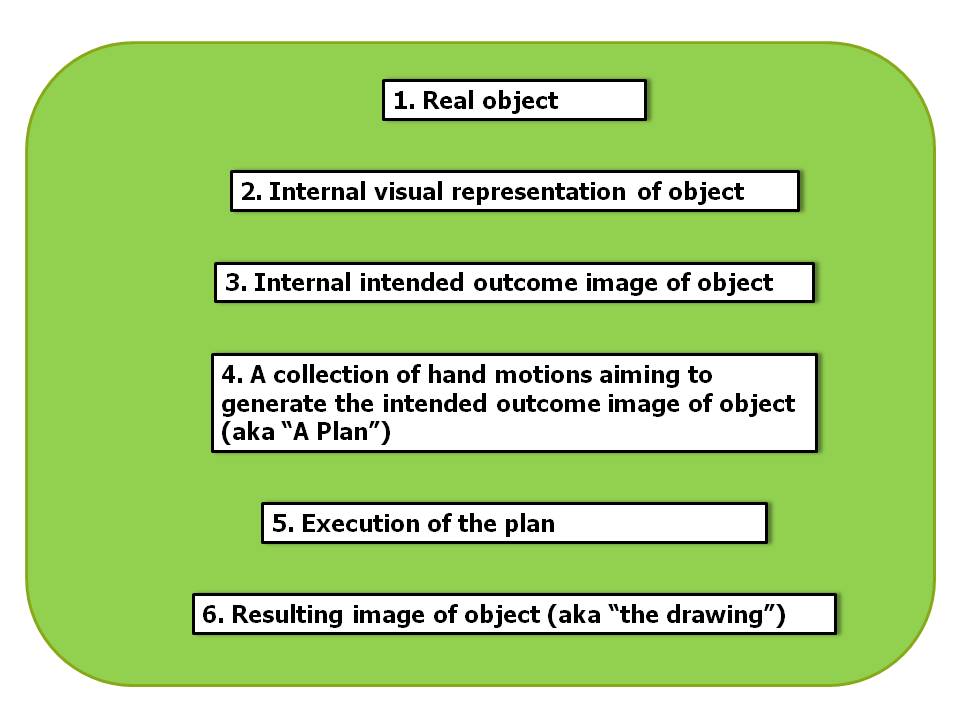
After reading Cain’s book, I realize that one could represent the process of representational drawing as a sequence of transformations,  from real object, through to output image (“the drawing”), as follows (click on the image to enlarge it):

Because this image does not seem to always render properly, I repeat here in text the 6 boxes shown in the figure:

  • 1. Real object
  • 2. Internal visual representation of object
  • 3. Internal intended outcome image of object
  • 4. A collection of hand motions aiming to generate the intended outcome image of object (aka “A Plan”)
  • 5. Execution of the plan (drawing as an action)
  • 6. Resulting image of object (aka “the drawing” as a noun)

It is important to realize that the entities represented by the six boxes here are of different types.  Entity #1 is some object or scene in the real physical world, and entity #6 is a drawing in the real physical world.  Entities #2 and #3 are mental representations (or models) of things in the real physical world, internal to the mind of the artist.  Both these are abstractions; for example, the visual model of the artist of the object may emphasize some aspects and not others, and the intended drawing may do the same. The artist may see the colours of the object, but draw only in black and white, for instance.

Entity #4 is a program, a collection of representations of atomic hand movements, which movements undertaken correctly and in the intended order, are expected to yield entity #6, the resulting drawing.  Entity #4 is called a plan in Artificial Intelligence, a major part of which is concerned with the automated generation and execution of such programs.  Entity #5 is a label given to the process of actually executing the plan of #4, in other words, doing the drawing.

Of course, this model is itself a simplified idealization of the transformations involved.  Drawing is almost never a linear process, and the partially-realized drawings in #6 serve as continuing feedback to the artist to modify each of the other components, from #2 onwards.

References:

Patricia Cain [2010]:  Drawing: The Enactive Evolution of the Practitioner. Bristol, UK: Intellect.

A salute to Charles Hamblin

This short biography of Australian philosopher and computer scientist Charles L. Hamblin was initially commissioned by the Australian Computer Museum Society.

Charles Leonard Hamblin (1922-1985) was an Australian philosopher and one of Australia’s first computer scientists. His main early contributions to computing, which date from the mid 1950s, were the development and application of reverse polish notation and the zero-address store. He was also the developer of one of the first computer languages, GEORGE. Since his death, his ideas have become influential in the design of computer interaction protocols, and are expected to shape the next generation of e-commerce and machine-communication systems.
Continue reading ‘A salute to Charles Hamblin’

Poem: This World

Today’s poem is by Emily Dickinson (1830-1886), New England transcendentalist, and written about 1862.

This World is not Conclusion.
A Species stands beyond –
Invisible, as Music –
But positive, as Sound –
It beckons, and it baffles –
Philosophy – don’t know –
And through a Riddle, at the last –
Sagacity, must go –
To guess it, puzzles scholars –
To gain it, Men have borne
Contempt of Generations
And Crucifixion, shown –
Faith slips – and laughs, and rallies –
Blushes, if any see –
Plucks at a twig of Evidence –
And asks a Vane, the way –
Much Gesture, from the Pulpit –
Strong Hallelujahs roll –
Narcotics cannot still the Tooth
That nibbles at the soul –

Reference:
Brenda Hillman (Editor) [1995]: Emily Dickinson: Poems. Boston, MA, USA: Shambhala.