Thanks to Norm, I learn about an attempt to brand religious belief and religious worship immoral, by Scott F. Aikin and Robert B. Talisse. It is apparently immoral to believe propositions for which one does not have evidence. My first reaction is to infer that neither author is an entrepreneur, famously people who strongly believe things (for example, that they will be successful) for which the evidence is usually absent or if not absent, then mostly contrary. And neither author must be a pure mathematician or an artist, people who pursue dreams or visions while only having vague intuitions or intimations of their truth. Mathematics (and hence most of modern science and technology) would come to a sudden, shuddering halt if mathematicians could only cogitate or publish on that which they could first prove. Mathematicians even have a name for results they suspect are true but cannot yet prove: conjectures.
Of course, the greatest defence against this attack on religion is that most religious believers DO indeed have evidence for their beliefs, as I have repeatedly argued before. Of course, this evidence is usually not independently verifiable or replicable, which makes it inappropriate for use in the social activity we call science. But that fact does not alone disqualify its use as a basis for deciding personal beliefs or personal actions. The state of being in love is also not independently verifiable or replicable (at least not yet), but most of us do not therefore not use it as a basis for personal decision-making, and nor should we.
The ignorance Aikin and Talisse demonstrate about religion is shown also in their argument about worship: Not all believers in or practitioners of religious ideas are engaged in the worship of divine entities. One could make a very strong case that worship plays no part at all in Buddhism or in Taoism, or in the mystic strains of other religions, such as Sufism or the Kabbala. These traditions seek to commune with the divine, not worship it. Perhaps this distinction is lost on people without personal experience of non-material realms, but most pure mathematicians would get it, since they commune with, but do not worship, mathematical entities.
Aikin and Talisse reject religious worship as being demeaning to the dignity of an autonomous human person. Why so concerned with human autonomy in this aspect, while striving a few paragraphs earlier to prevent humans autonomously choosing what to believe? Like Richard Dawkins they not only want to think for themselves, but also want to think for everyone else too. As an autonomous human, I disdain and reject their attempt at mental colonization.
Given such a weak case, one wonders why they make it with such stridency.
Author Archive for peter
Page 48 of 85
Rythmica ps
LondonJazz has a review of Rhythmica’s recent concert at the QEH here. And links to some videos are here on Rhythmica’s pages. Be delighted, be very delighted!
Next concert on the Rhythmica Wake-up-the-Nation tour is in Cambridge on 13 March 2011 at Clare Jazz, Clare Cellars, Memorial Court, Queen’s Road, Cambridge CB3 9AJ.
Cocktails with Rhythmica
Another superb gig from Rhythmica, this time in the Cafe of Foyle’s Bookshop in London. After last weekend’s wake-up call in Southport, tonight’s gig was at a more civilized hour. But the pace and the musical skill and the serious intent were just the same – anyone expecting easy-listening, cocktail-bar music was in for a shock!
With about 75 people present, it was standing room only. Standing at the back, I found Peter Edwards’ piano hard to hear – maybe it was not amplified, or not sufficiently. I enjoyed again bass Peter Randall’s solo in Parallel, a solo which seemed to have more coherence tonight, or perhaps I understood the motifs and their development better this time round. Andy Chapman on drums provided solid support for the odd time signatures, and I noticed again the frequent rhythmic coupling and tripling he did with Randall’s bass and Edwards’ piano.
I was also impressed by Mark Crown’s superfast bop trumpet solo on Herbie Hancock’s The Sorcerer. But the man of the match tonight was undoubtedly stand-in tenor sax player, Binker Golding, whose blistering, vein-popping solo on the same number had the audience up in a standing ovation when he ended. Even the two Dutch women near me who talked through the entire set were quiet for this, although they still didn’t look at the stage.
As best I recall, the order of songs was:
- Time Machine (Audu)
- Anthem (Edwards)
- Parallel (Joe Harriott)
- Turner’s Dream (Crown)
- Triple Threat (Edwards)
- The Sorcerer (Hancock)
- Blind Man’s Stomp (Golding).
Can’t wait to hear these guys again!
UPDATE (2011-02-18): A video of Binker’s blistering solo is here, and photos of the gig here.
Yamba Surf Club
Yamba Surf Club (founded 1908) damaged by fire, 8 February 2011.
And here is a web-cam for Yamba beach:
Yamba web-cam
Honeywell International Inter-varsity Debating Festival 1978
On 17 July 1978, the ABC TV current affairs programme, Monday Conference, held a Parliamentary Debate at Sydney University with participants from the Honeywell International Inter-varsity Debating Festival, then being held in Sydney: universities represented included Auckland, Cambridge, Canterbury (NZ), Columbia, Glasgow, Harvard, Nairobi, Oregon, Oxford and eight Australian universities. Particularly memorable performances were given by Nicholas O’Shaughnessy (age 26) from Oxford and David Pash (age 19) from Harvard. Pash, speaking of O’Shaughnessy’s speeches, remarked:
They fall into three categories: the witty, the stirring, and the vast majority.”
Pash also said:
Where there’s smoke there’s fire. Or, in Latin, Nil combustio sic profumo.“
Pash is now an attorney in LA, and O’Shaughnessy Professor of Communication at Queen Mary, University of London. Ewan Sutherland, a participant from Glasgow and now a telecommunications consultant, has a short report of the Debating Festival here.
Following the Festival, the student newspaper of the Australian National University (ANU), Canberra, Woroni, reported on a visit to ANU by the Oxford University Union Debating Team (issue of 1 August 1978). This report (with obvious typing errors corrected, one ellipsis added, and one misplaced line – shown by [ ] – re-inserted appropriately) is here:
Complete with jokes generously supplied by the FitWilliam [sic] Museum of Antiquities in Cambridge, the Oxford University Union Debating Team visited Canberra for four days at the beginning of second semester. The team was in Australia along with teams from Cambridge, Glasgow, Harvard, Columbia, Oregon, Auckland, Canterbury and several Australian universities including ANU for the first Honeywell International Inter-varsity Debating Festival in Sydney.
Despite the fact that all four members of the team are part of Margaret Thatcher’s shock troops (she was described by one of them as Attila the Hen), they were almost human. Nicholas O’Shaughnessy wants to be Viceroy of India and developed an accent to match. John Harrison . . . found solace in the company of Greg Carman. Marie-Louise Rossi replaced at 4 hours notice a past president of the Oxford Union, Vivienne Dinham. Mark Sterling, in between drams, managed to defeat the cream sherry of ANU Law School mooting talent, Tom Faunce and Lee Aitken.
There were two debates in Canberra. The first, on 19th July, was against ANU, ably represented by Andrew Byrnes, Steve Bartos and Vivienne Bath. The subject was ‘That Only God can Save the Queen‘, which Oxford negated. By any standards it was a good piece of comedy, though not perhaps describable as a debate. Oxford were rather the worse for wear, having staggered off a plane from North Queensland just 1.5 hours before the debate began.
On 20th July there was a highly successful debate in the Albert Hall against a team from parliament. It proved very difficult to get any MPs at all. Most of the ALP were overseas on their compulsory annual junkets. Many Liberals were [ ] discreetly elsewhere on the date of the debate. No member of the National Party could be found who could string more than about three words together before collapsing in exhaustion. In the end we found Michael Baume, Jim Carlton and Michael Hodgman, who turned on a very entertaining performance. They admirably proved that talent is in inverse proportion to one’s chances of becoming a minister.
On July 21 the Law School staged a moot and lost. Oxford left for Melbourne on July 22, having only managed [to see Canberra in the wet. Every time] that a trip was planned, the heavens opened.
On a marginally more serious note, the success of the Oxford visit has prompted the Union to try and re-establish Union Night Debates on a regular weekly basis. These debates are an established and popular feature of many English and Australian universities, and were common here until a few years ago. If anyone wants to help on the Union Debates Committee, go and talk to someone in the Union Office.
The article was accompanied by a photo of the 19 July debate participants, showing seated (left-to-right) under a portrait of the Queen and a British and an Australian flag: John Harrison, Marie-Louise Rossi (1956-2014), Nicholas O’Shaughnessy, Greg Carman (MC), Vivienne Bath, Steven Bartos and Andrew Byrnes. I attended the debate on 19 July 1978.
Breakfast with Rhythmica
Earlier today I caught a rainy, late morning gig by Rhythmica as part of the Southport Jazz on a Winter’s Weekend Festival. The quintet comprises Mark Crown on trumpet, Peter Edwards piano, Peter Randall double bass, Andy Chapman drums, and Zem Audu on sax. Audu was absent today, his place taken by Binker Golding on tenor sax. There were perhaps 150 people in the audience, with only a handful looking younger than 50. Maybe everyone younger was still asleep.
What a way to wake up! From the first three bars of the first number – Time Machine – you knew these guys were serious – they were people to be reckoned with. The piece was in 11/4 (or perhaps one bar in 3 beats to every two bars in 4), and they were extremely together! Piano and bass were in close unison for an ostinato bass line, trumpet and tenor sax together in similar unison for the melody. And everyone – all 5 – in very tight formation. The close co-ordination was evident throughout the morning, with the players grouping mostly as for Time Machine.
The use of trumpet and sax together, sometimes in unison, sometimes playing seconds and thirds (especially at the ends of unison phrases), with the piano riffing between phrases, as if commenting from the sidelines on the melody, is a feature of Wynton Marsalis’ compositions, and before him, of Wayne Shorter and others in the early 60s. This produces what I find is a very attractive sound, and Rhythmica did it very well. Anthem was in this vein. Sometimes also the bass and drums would double (as in Mr JJ), and just once we also heard trumpet, sax and piano play unison/thirds choruses together, in the aptly named Triple Threat. And for the final chorus of Solace, Crown’s trumpet played long-held falling fifths underneath everyone else’s bop gyrations; these were just sublime.
In a lineup of excellent performers, the standout for me was bass player Peter Randall – he was fast, agile, and with lots of interesting walking lines – and using all five fingers to stop strings in the high registers. But we only heard him solo once (in Parallel) – it would be good to hear more of him.
As best I recall, the order of songs was as follows:
Set 1:
- Time Machine (written by Audu)
- Anthem (Edwards)
- Delfeayo’s Dilemma (Wynton Marsalis)
- Turner’s Dream (Crown)
- Mr JJ (Jeff “Tain” Watts)
Set 2:
- Triple Threat – The Bridge (Edwards)
- Parallel (Joe Harriott)
- Solace (Edwards)
- The Sorcerer (Herbie Hancock)
- Blind Man Stomp (Golding).
The last number was a great New Orleans stomp written by Binker Golding, which the crowd loved – perhaps showing their real preference would have been for something more traditional. Myself, I was happier with what came before. Counting 11 to the bar certainly woke me up PDQ!
UPDATE (2011-02-06): I have now listened to their debut CD. Confirms my view that these guys are not people you’d want to mess with. They have some serious intent and the strong musical skills to achieve it. This is great music.
UPDATE #2 (2011-02-08): The band’s next outing is in a bookshop! First, pre-dawn Saturday morning gigs, then playing in libraries! What next? An appearance on The Archers? Or music to accompany a TV cooking program?
Recent Listening 5: Hungarian Modern Jazz
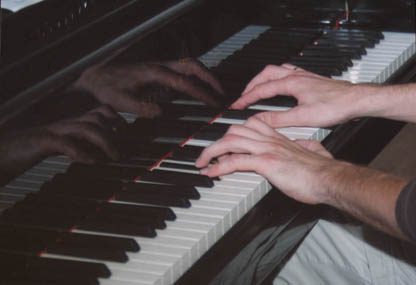
A quick mention of various Hungarian jazz CDs that I’ve been listening to this week, some of the music cool and some hot. I have heard several of these performers live, and hope to do so again: pianist Szabo Daniel (whose hands are shown above), double bassist Olah Zoltan (playing on both the Toth Viktor and the Budapest Jazz Orchestra CDs), and the superb Trio Midnight.
Szabo Daniel [1998]: At the Moment. Hungary: Magneoton/Germany: Warner Music.
Trio Midnight [1999]: On Track. Featuring Lee Konitz. Budapest, Hungary: Well CD 2000.
Toth Viktor Trio [2000]: Toth Viktor Trio. Budapest, Hungary.
Budapest Jazz Orchestra [2000]: Budapest Jazz Orchestra. Budapest, Hungary. Recorded at Aquarium Studio.
Note: Entries in this series here.
Bam's rhetoric
Posting about one of Bam’s 2008 campaign speeches reminded me of the analysis undertaken by The Guardian’s arts correspondent, Charlotte Higgins, on the Roman and Greek rhetorical devices in his major speeches. Relatedly, textual analyses of Bam’s 2008 Presidential election victory speech can be found here and here.
Red River
One of my favourite films is Howard Hawks’ Red River (1948), which pitted John Wayne against Montgomery Clift. I came across an insightful review of the movie by Roderick Heath, here. The one aspect of the movie not mentioned in that review is the context in which the movie was made, immediately after World War II. At the time, the allies had large military forces being demobilized, with men – they were mostly men – returning with all deliberate speed to civilian life. Many of these men had played responsible and important roles in the war effort, roles requiring intelligence, personal initiative, courage, and the leadership of others. They returned to Civvy Street to find senior management posts occupied by the generation before them, and only subordinate roles available for themselves; they were often immensely frustrated. I once heard of a businessman’s club memorial dedicated To the Men Whose Sons had Given Their Lives in World War II, which sums up for me the self-regard of the elder of these two generations.
With this context in mind, I see Red River as a parable about the struggle between the two generations for the control of business and society in the post-war world. Clift’s caring and listening leadership style resonated much more with returning military men than Wayne’s deaf and inflexible approach, as it does also in the film with Wayne’s cattle drovers. In Japan and Germany, of course, the generation before had made a mess of things, and so there were greater opportunities in the post-war period for the next generation to take immediate charge.
Last Tango in Braidwood
Here is a review of a concert of student compositions, held at the then Canberra School of Music, on 31 October 1978, which I wrote at the time.
It is interesting that the student composer of one of the least impressive works played at that concert should end up as a professional composer (Knehans), while that of the most impressive, it seems, did not (McGuiness). But the style of McGuiness’ piece was closer to what we now call downtown, and I have never been much impressed with uptown contemporary music, despite its hold on the academy and the new music establishment. My sympathies for downtown and antipathy to uptown music has as much to do with the various aspirations of these styles as with how the resulting music sounds.
Ian Davies: Last Tango in Braidwood or I Might be Wrong. Very good – at times impressionistic, at other times expressionistic. Owes a lot to Sculthorpe (before his turn to late romanticism). Good stereo effects. Held together well, except for the ending. The last 15% of the piece would be better deleted and replaced by something much shorter, and more unified with the first 85%.
Alexandra Campbell: Harmonic Music. More harmonic than Davies’ piece, but not at all traditional. The piece seemed to lack any unifying idea, and just seemed a series of random statements, the phrases disconnected and unrelated. A pity, because some of the individual phrases were nice-sounding. Showed clear understanding of instrumental possibilities, especially the winds – perhaps fittingly for a composer who plays the oboe.
Richard Webb: Cube. If the previous piece was incoherent, this was completely incomprehensible. Like listening to someone speaking in an unknown foreign language, not even the individual phrases made sense. The piece was just a cacophony of effects, overloud and overlong.
Richard Webb: Maya. A tape realization, this was also overloud and overlong. Not gebrauchsmusik, but boretheaudiencemusik. Listening to electronic special effects in 1978 brings to mind only Star Wars and science fiction novels, so perhaps these effects can’t be used any longer. The audience began to talk about 3/4 of the way through, so my boredom was not unique.
Andrew McGuiness: Simple Music (for Simple People). This was superb! Fantastic! The ensemble stood in darkness and played according to graphic instructions written on paper affixed to the wall, each page of instructions illuminated by a lady (Alex Campbell) holding a torch, as it was being played. Sitting in the dark with just the torch light, it felt like we were watching a sunrise. And the music mirrored this feeling perfectly, though it was not programmatic or symbolic at all. The music was impressionistic and at times pseudo-Balinese (again, a la Sculthorpe). One discord was sustained throughout, I think on an electric piano or on a synth set to “harpsichord”, perhaps. Simply marvellous.
Peter Butler: Champagne will be Served at Interval. Butler played chimes and electronic piano at front. The e-piano was too loud, especially in comparison with the acoustic piano at rear. Apart from this the piece was very good. The “form” was a call-and-response structure, with the call issued by one of the five sections (strings; e-piano; piano; guitar and flute; and guitar and flute) to another, with the chimes intervening every so often to signal a climax, or perhaps an anti-climax. The calls – were these questions? – occasionally became fierce, with loud crescendos and sustained ranting, usually ending abruptly or halted by a clang of the chimes. Certainly, as the notes said, a snakes-and-ladders piece. Apparently, only the outline was sketched by the composer, with details added by the performers. It would be interesting to see the score. This was the most expressionistic piece of the evening (ignoring the tape realization).
Peter Butler: One Dollar per Glass. A piece for solo guitar, performed by Brian Lewis, this was a collage of special effects: tapping of the base of the guitar; playing it with a cello bow, a beer glass and a spoon; and re-tuning the instrument while it was being played. The second half of the piece was more overboard with effects than the first, which at least required some guitar-playing skills from the performer.
Douglas Knehans: Survey in Regions (A Tragedy in 4 Parts). Structured on Eliot’s poem, Portrait of a Lady, the piece was supported by rude tape noises. Some of these tape recordings were verses of the poem, although others sounded like Ronnie Barker speaking. I was unable not to laugh each time Barker’s voice was heard. The piece seemed sentimental and insincere, because so many cues in the poem were missed or ignored: “attenuated tones of violins, Mingled with remote cornets”, “a dull tom-tom begins”, etc. The only excitement was visual, since the performers each played many instruments (although only ever one at a time), so that everyone was running around: organist to xylophone, and then back; guitarist to bass drum and back, only to be followed to the drum immediately by the lady percussionist. Musically, the piece made no sense to me, although the organ had some nice phrases now and again.