Belligerent musical ignorance

Via Tom Service, I learn of a new blog seeking to define classical music in such a way as to exclude anything the writers do not themselves like.

I wonder, first, what is the point.  Why can’t people be happy with their own preferences, their own choices, and leave other people to be happy also with their respective preferences and choices?  What deep sense of anxiety or profound inferiority leads people so often to try to force others to make the same aesthetic choices as themselves, or, if unable to force that, to disparage the choices of others?  There has to be something profoundly wrong with a person’s aesthetic philosophy or with their psyche if they undertake rule-mongering in order to defend their own preferences.
Second, seeking to include only the music they like and to exclude the remainder, the writers of this new blog present an axiomatization for what they refer to as “Art Music”.   They use the term Art Music, but I think Autistic Music would be a better fit.  Putting aside the cultural assumptions inherent in undertaking axiomatizations (something for another post), let’s examine their proposed axioms (numbered for ease of reference).  I first list the axioms and then I interpolate my responses.

To count as Art Music, a work must meet ALL* the following criteria:
1. It must be written for acoustic instruments and/or unamplified voices (mechanical and electr(on)ic devices may also be employed for textural effect)
2. It must be the original work of a single author (texts notwithstanding)
3. It must be preserved and transmitted as a score, written in orthodox musical notation, alterable only by the composer (unless the composer dies before completion)
4. It must stand on, or peer over, the shoulders of giants, i.e. acknowledge, build on or work from 1000 years of fundamentally accumulative history from the so-called Medieval, Renaissance, Baroque, Classical, Romantic and Modern (see right) eras (or their equivalents in non-Western cultures)
5. It must be conceived for performance according to the instructions and faithful to the intent of the composer (performers always following the score precisely in as much detail as the composer provides; improvisations and ornamentations permitted where the composer allows or expects)
6. It must be musically and intellectually complex, coherent and sophisticated, i.e. display and encode, in various permutations, originality, discursiveness, subtlety, intricacy, symbolism, logic, humour etc through the use (in various combinations) of development-over-time (through-composition), advanced harmony, modulation, variation, variance of musical phrase length, counterpoint, polyphony etc. It will therefore:
6.1 Require a high level of musicianship (concentration, insight, accomplishment) on the part of performers, who must draw on musical education, personal experience and imagination, knowledge of a work’s idiom, and the accumulated body of historical performance practices even for a merely competent performance
6.2 Require relatively high levels of concentration, understanding and competence from listeners for appreciation and (even basic) comprehension
6.3 Be susceptible to detailed theoretical analysis
7. It must aspire to provide the listener with emotional and intellectual enjoyment and satisfaction, by communicating through musical complexity, sophistication and coherence exceptional and/or transcendent reflections on the human condition

In reality this is an anti-modern, anti-jazz, anti-downtown, anti-world music, anti-rock, anti-pop, anti-folk, anti-hip hop manifesto.  Most of the music excluded is music by non-white peoples.  Perhaps it is just a coincidence that the music which passes these rules is mostly written by dead, white, European males, or perhaps the authors really are the racists that these rules would suggest.

It is hard to know where to start with such an absurd list, so let us proceed in order.

1. It must be written for acoustic instruments and/or unamplified voices (mechanical and electr(on)ic devices may also be employed for textural effect)

First the restriction to written texts (#1, #3) excludes all of improvised music  – that’s music by people like Bach, Buxtehude, Mozart, Beethoven, Mendelssohn, etc,  not to mention jazz, klezmer, gypsy, indian music, gamelan, etc.

Axiom #1 also requires that mechanical and electronic instruments only be used for textural effects.  There goes the organ repertoire!  Baroque organs were perhaps the most sophisticated mechanical devices in the pre-modern era, and the large ones required at least two human operators  – one person to play the keyboards and one or more to pump the bellows.    And every modern trumpet, cornet, French Horn, tenor horn, euphonium and tuba uses a mechanical device called a valve, while Bb/F trombones use a switch to change from tenor to bass. So all the brass repertoire since about 1800 disappears too.   And, indeed, keyboard instruments like the harpsichord and the piano use mechanical devices to transfer action executed by the performer to actions executed by the instrument. Even the sound and the means of performance of string instruments have been changed with new technologies, such as new materials for bows and the invention of shoulder-rests.  A violin shoulder rest, for instance, means the left-arm of the violinist is no longer required to maintain the violin in position under the player’s chin.  That in turn means the performer’s left hand can zip up and down the finger board with far greater rapidity and flexibility.   The 19th and 20th century violin repertoire would be mostly unplayable without shoulder rests.

The irony in using a web-page to argue for acoustic instruments seems to have escaped these authors.  I honestly don’t understand the mentality of people who favour so-called acoustic instruments.  The instrument with the cleanest interface between human action and sound output is undoubtedly the theremin, where the performer touches nothing, and merely (after long practice!) waves his or her hands in the air.   Technologically, this instrument is as unsophisticated as stone-age fire in comparison to the sophistication involved in the design, construction and maintenance of a modern piano or, for that matter, a baroque organ.  So an intellectually-coherent set of musical axioms could hardly include the piano while excluding the theremin – unless there is something immoral about using electricity to aid sound production.

But in that case (as I have long argued contra to the authentic performance movement), why perform in air-conditioned halls lit by electric light?   If you limit yourself to acoustic instruments, then surely intellectual consistency would require performance in halls or rooms without any other modern convenience.   The actual sound – as produced by the musician, and as perceived by the listener  – will be influenced by the ambient temperatures in the performance venue.  If you think this comment is a trivial one, then you have never played a brass instrument in a cold hall or outside on a winter’s day.

2. It must be the original work of a single author (texts notwithstanding)

Axiom #2 requires that the work  be single-authored.  What of Bach’s reworking then of Vivaldi’s music? What of Gounod’s “Ave Maria”, a melody famously set to a prelude by Bach?  I rather like that setting, as indeed I expect the authors of these axioms would.  Axiom #2 also excludes most of jazz, world music, rock, etc.

3. It must be preserved and transmitted as a score, written in orthodox musical notation, alterable only by the composer (unless the composer dies before completion)

The restriction to orthodox notation (#3) excludes some of the greatest music of the last 50 years, which is perhaps the authors’ intention.  But what of figured bass notation?  Is this traditional?  It was once, but has not been so much used these last 150 years.  Since its use implies an improvisational stance to music, perhaps its loss is also
intentional (as per #1).

But anyway, what is so special about orthodox notation?  Elsewhere on the site, the authors say they aim “to repudiate cultural relativism in music”.   But what is more culturally-relative than musical notation?  The standard notation we use in the west today is culturally and historically-specific. It is by no means the only notation. It is not even necessarily the best notation – it fails, for example, to adequately represent divisions of the octave into other than 12 pitch-classes; it does not deal well with unequal temperament or with dynamic pitches or with polyrhythms or allow precise gradations of dynamics; it ignores timbre; it mostly overlooks sound production (ask Morty Feldman about that!) and it is harder to learn than some other notations (eg, popular guitar chords symbols), etc.   Like any system of representation of human knowledge it has strengths and it has weaknesses.  But these authors proclaim “Art Music is in many ways objectively superior to Pop ‘Music’ “ and yet insist on using a culturally-specific notation with known weaknesses.

4. It must stand on, or peer over, the shoulders of giants, i.e. acknowledge, build on or work from 1000 years of fundamentally accumulative history from the so-called Medieval, Renaissance, Baroque, Classical, Romantic and Modern (see right) eras (or their equivalents in non-Western cultures)

Well all music (and indeed all art) does this, even when it ignores the giants.  This axiom reveals the ignorance of the authors, since even their hated pop musicians “build on or work from” the music of their predecessors.   And here suddenly here we have an allowance for non-Western music.   Most of these musics were excluded by Axioms 1 (which requires music to be “written”) and 2, so including them here would seem to be just some weak attempt to prove the authors are not racists after all.   Nothing in the other axioms would lead one to think that the authors really like or understand, for example, Javanese gamelan or Shona mbira music, or perhaps even know what they are.

5. It must be conceived for performance according to the instructions and faithful to the intent of the composer (performers always following the score precisely in as much detail as the composer provides; improvisations and ornamentations permitted where the composer allows or expects).

Oh dear.  Here and in Axiom #3 we have the romantic fallacy that performing musicians are mere slaves to the will of the god-composer.  Have none of the authors ever listened to Chopin’s music?  Almost every performer of Chopin’s solo piano music — INCLUDING CHOPIN HIMSELF – plays with rubato, an elongation and compression of time, like a natural breathing, rather than a rigid adherence to a beat.  None of this breathing is marked on the score, but is always and everywhere decided by the performer, as if on-the-fly.

But the performer is only part of the story.  A musical work also requires an audience.  It is the complete trio – composer, performers, audience – who interpret a piece of work, not any one of the three.  Go read the books of Mark Evan Bonds to see how crucial the audience is for understanding the meaning of a musical work, and understanding how it should be read and performed.  The ignorance the authors reveal here of western music history – ie, the history of the very music the authors claim to be promoting  – is simply stunning.

6. It must be musically and intellectually complex, coherent and sophisticated, i.e. display and encode, in various permutations, originality, discursiveness, subtlety, intricacy, symbolism, logic, humour etc through the use (in various combinations) of development-over-time (through-composition), advanced harmony, modulation, variation, variance of musical phrase length, counterpoint, polyphony etc. It will therefore:

Well, all music is “musically and intellectually complex, coherent and sophisticated”.  Because the authors first require “advanced harmony”, I suspect the intent here is to exclude minimalist, downtown and rock music.   If the authors think that any of these musics is not complex and sophisticated, they are simply not listening.   (It is something truly strange to ponder why so many trained uptown musicians can hear downtown or pop or non-western music without actually listening to it; I guess the answer is in their training.) 

The complexities in these musics often lie in places elsewhere than in music in the main thread of western classical music — for example, in the interplay of multiple, intersecting rhythms rather than in harmonies.  But complexities there certainly are.  If you limit yourself to music which is only harmonically complex, for example, you’d also have to forget the pre- and early-Baroque, along with 20th century composers like Shostakovich, Orff, Satie, or the Ravel of Bolero.    Of course, you’d get all the Wagner you could possibly want, although that trade would not satisfy me at all.

6.1 Require a high level of musicianship (concentration, insight, accomplishment) on the part of performers, who must draw on musical education, personal experience and imagination, knowledge of a work’s idiom, and the accumulated body of historical performance practices even for a merely competent performance

See comment to #6.

6.2 Require relatively high levels of concentration, understanding and competence from listeners for appreciation and (even basic) comprehension

See comment to #6.

6.3 Be susceptible to detailed theoretical analysis

See comment to #6.  Anyone who thinks that popular music, for example, is not susceptible to detailed theoretical analysis, is simply ignorant.

7. It must aspire to provide the listener with emotional and intellectual enjoyment and satisfaction, by communicating through musical complexity, sophistication and coherence exceptional and/or transcendent reflections on the human condition

See comment to #6.

The contemptible views expressed on the site are very similar to those I’ve heard expressed before by uptown composers such as Harrison Birtwistle.   Is this website the uptown response to downtown and popular music?  Shoot-out at  autistic musical gulch, perhaps?   It is hard to imagine that people with such views still exist, let alone that they have heard of the web.  But that is enough dragon-slaying for now. I will sure have to more to say in a future post.

Update (2018-03-25): The site was musoc.org, but it now seems to have disappeared.

References:
Mark Evan Bonds [2006]: Music as Thought:  Listening to the Symphony in the Age of Beethoven. Princeton, NJ, USA: Princeton University Press.
Mrs Palin

Peggy Noonan was a speech-writer for Ronald Reagan, and she can still throw a serrated-edged dagger at high-speed with a precision of millimetres.  Here she is (in her column of 2009-07-10) on one Mrs Palin:

In television interviews she was out of her depth in a shallow pool. She was limited in her ability to explain and defend her positions, and sometimes in knowing them. She couldn’t say what she read because she didn’t read anything. She was utterly unconcerned by all this and seemed in fact rather proud of it: It was evidence of her authenticity. She experienced criticism as both partisan and cruel because she could see no truth in any of it. She wasn’t thoughtful enough to know she wasn’t thoughtful enough. Her presentation up to the end has been scattered, illogical, manipulative and self-referential to the point of self-reverence. “I’m not wired that way,” “I’m not a quitter,” “I’m standing up for our values.” I’m, I’m, I’m.”

I doubt I could ever support a party of irrational economic policies, incompetent war-mongering, and class resentments such as the GOP.  But if I were inclined, then I’d agree also with these words:

Here’s why all this matters. The world is a dangerous place. It has never been more so, or more complicated, more straining of the reasoning powers of those with actual genius and true judgment. This is a time for conservative leaders who know how to think.
Here are a few examples of what we may face in the next 10 years: a profound and prolonged American crash, with the admission of bankruptcy and the spread of deep social unrest; one or more American cities getting hit with weapons of mass destruction from an unknown source; faint glimmers of actual secessionist movements as Americans for various reasons and in various areas decide the burdens and assumptions of the federal government are no longer attractive or legitimate.
The era we face, that is soon upon us, will require a great deal from our leaders. They had better be sturdy. They will have to be gifted. There will be many who cannot, and should not, make the cut. Now is the time to look for those who can. And so the Republican Party should get serious, as serious as the age, because that is what a grown-up, responsible party—a party that deserves to lead—would do.
It’s not a time to be frivolous, or to feel the temptation of resentment, or the temptation of thinking next year will be more or less like last year, and the assumptions of our childhoods will more or less reign in our future. It won’t be that way.
We are going to need the best.”

Art as Argument #3: commutative diagrams in Category Theory

Following these posts on whether art could be understood as arguments, I turn attention to diagrams in pure mathematics.   I know of only two areas of mathematics where diagrams are used frequently as arguments in proofs, rather than simply as illustrations of arguments or proofs expressed in algebraic symbols. One area is Euclidean Geometry, which most of us learn in school. The other is category theory (CT). It is interesting that one of the oldest and one of the youngest branches of pure mathematics should be the only ones using diagrams in this way. Perhaps the rise of CT is another signal of the decline of the three-centuries-long dominance of the written word over western culture.
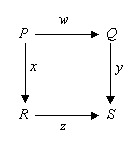
First, here is an example of a typical commutative diagram from category theory:
Commutative diagram square
This particular diagram expresses an equivalence:  that in traveling from P to S, it does not matter whether we travel via Q or we travel via R, the end-result will be the same.  (Category theory makes this notion of “same-ness” or equivalence quite precise; indeed, in some sense CT is a formal theory about different notions of equivalence and their relationship to one another.)  Thus, the diagram is making a claim about the (mathematical) world, a claim which may include its own proof:  that executing function (or action) w followed by function y is the same as executing function x followed by function z.
Let us see what CT textbooks say to justify the subject’s use of diagrams. The standard reference on CT for mathematicians is the book by Saunders Mac Lane. An easier introduction is the book by Lawvere and Schanuel. Both of these simply start using diagrams as proofs without any justification for the practice, although they both formally define the diagrams concerned. In the book by Barr & Wells, we find:

When the target graph of a diagram is the underlying graph of a category some new possibilities arise, in particular the concept of commutative diagram, which is the categorist’s way of expressing equations.” (page 93)

Later in the same chapter they say:

This point of view provides a pictorial proof that the composite of two graph homomorphisms is a graph homomorphism. . . . . . The verification process just described is called “chasing the diagram”. Of course, one can verify the required fact by writing the equations (4.14) and (4.15) down, but these equations hide the source and target information given in Diagram (4.13) and thus provide a possibility of writing an impossible composite down. For many people, Diagram (4.13) is much easier to remember than equations (4.14) and (4.15). However, diagrams are more than informal aids; they are formally-defined mathematical objects just like automata and categories. (page 96)

Mac Lane says (p. 29) that the use of arrows as a graphical representation of functions was introduced by Hurewicz in about 1940, and that he also probably first used commutative diagrams. Like many practices in mathematics, one learns about the use of diagrams as proofs in CT in the classroom. Despite the textual (ie, non-diagrammatic) nature of most pure mathematical writing, parts of applied mathematics and theoretical physics (e.g. Feynman diagrams) use diagrams although pure mathematicians may question whether these disciplines are actually doing “proving”.
References:
Michael Barr and Charkes Wells [1999]: Category Theory for Computing Science. Montreal: Les Publications CRM, 3rd edition.
W. Hurewicz [1941]: On duality theorems. Bulletin of the American Mathematics Society, 47: 562-563.
F. W. Lawvere and S. H. Schanuel [1997]: Conceptual Mathematics: A First Introduction to Categories. Cambridge: CUP.
Saunders Mac Lane [1998]: Categories for the Working Mathematician. Berlin: Springer, 2nd edition.

The French Member of the English Language Committee of the IMO

The International Mathematics Olympiad is a famous international competition for mathematics students. This is an excerpt from the diary of the Chairman of the English Language Committee (ELC) of the 2005 IMO , Geoff Smith:

In the evening I prepare for the English language committee which I will chair next day. This means I slope off to my room early and try to cast the questions in perfect English myself, in order to have something to start with.  The committee meets first thing in the morning. These days everyone is welcome in the ELC, including its most important member, the leader of France. We like to have simple sentences in IMO questions; ones which ideally can be translated almost word for word into as many languages as possible. French is rather special, and does not allow the rather free word order and grammatical latitude of English. Therefore the English language version has to be designed so that it can be easily translated into French. As each English sentence is suggested, we turn to FRA7, Claude Deschamps, to receive either a blessing (a shrug which indicates that all is well) or a sad shaking of the head which indicates that a particular piece of Anglo-Saxon thuggery simply cannot be expressed in French.”

HR runs amuck in NSW

The Sydney Morning Herald tomorrow reports that staff at the New South Wales Law Reform Commission are being invited to apply for their own positions.   Apparently, the current staff there are staying in their posts too long, thereby reducing staff turnover, with the serious consequence that: 

Zero turnover means that no opportunities arise to attract, develop or retain highly skilled employees.”  

It’s always the damn employees who cause trouble for the proper functioning of the Human Resources Department.   How can HR possibly execute policies to retain valuable staff if nobody ever threatens to leave!?

Obama the community organizer

Andrew Sullivan, in his British Sunday Times column yesterday, finally analyzes the MO of Barack Obama in terms of his background as a community organizer:

Obama is also, at his core, a community organiser. Community organisers do not jump into a situation and start bossing people around. They begin by listening, debating, cajoling, inspiring and delegating. Less deciders than ralliers, community organisers explain the options, inspire self-confidence and try to empower others, not themselves. If you think of Obama even on a global stage, this is his mojo. And those community organisers do not tell you to expect instant results. It takes time when you try to build real change from below. But the change is stronger, deeper and more real when it comes.

I guess I have to wonder what took you so long, Andrew?

Tony Benn in Rhodesia

Normblog today quotes an interview with former British Cabinet Minister and MP Tony Benn, talking about visiting Southern Rhodesia (now Zimbabwe) during WW II:
When I was there, there was no democracy at all: all the good land had been stolen and given to white farmers, no African had votes, it was a criminal offence for an African to have a skilled job; and now we lecture Zimbabwe on democracy – total hypocrisy.”
First, as so often with Benn, rhetorical effect takes priority over truth.   The franchise in Southern Rhodesia was not based on race, but on age, property ownership, income, and a test of English literacy.  Despite the inherent bias of these conditions (made worse by the use of a definition of “property” which excluded cattle, the main traditional form of black wealth), some black Rhodesians qualified to vote from the granting of self-government in 1923.  Of course, the number of black voters enrolled was tiny (in 1948, 248 non-whites to 48,000 whites enrolled), but even 248 is not zero.    Such a system allowed many white Rhodesians to convince themselves their electoral system was not racist.    The electoral situation in Rhodesia was undemocratic enough without Benn having to exaggerate it.
Second, the fact that any non-whites had the vote at all was due to British government insistence against the wishes of most of the Rhodesian white population, from 1898 onwards (see West 2002).  Benn’s statement jumps from a description of Southern Rhodesia in WW II straight to Zimbabwe in 2009, ignoring the campaigns for majority rule in the 1950s and 1960s, the international struggle and sanctions against the illegal UDI regime of Ian Smith, the British-sponsored negotiations leading to British-led peace-keeping forces, majority rule, and independence in Zimbabwe in 1980, and the political, technical, moral and financial support given by Britain for the newly-elected democratic Government of Robert Mugabe.   It is Mugabe and his ZANU-PF henchmen, not Britain, who have failed to honour the standards of democracy.   Like Norman Lamont in his deplorable support for the Chilean murderer Augusto Pinochet, Tony Benn seems to apply one standard to elections in Britain and another standard elsewhere.    As with Lamont, let me ask Benn:  Would it have been OK for John Major to have terrorized and murdered his opponents and refused to leave office when he lost the British election of 1997?  If not, then why is it OK for Robert Mugabe to do so?  Such a double standard strikes me as treating black people differently to white people.
 
POSTSCRIPT (2009-07-07):
The advisory Legislative Council established by the ruling British South Africa Company in Southern Rhodesia in 1898 had 6 appointed and 5 elected members, who were, from its creation, chosen under a non-racial franchise (see Walker 1953, p. 104).   This franchise was that in force in the Cape Colony, which itself dated from a Municipal Ordinance of 1836, which created a conditional, but colour-blind, franchise for some local governments based solely on ownership or rental of fixed residential property above stated monetary values.   Other tests, such as literacy in English, were added later to the conditions.  Indeed, the history of white rule in southern Africa in the 19th century can be seen as a fight between liberal, often colour-blind policies imposed from the Colonial Office in London but opposed by far-less-often liberal settlers, particularly those of Afrikaaner origin, who repeatedly left the area under British colonial jurisdiction to establish their own settlements further inland.
 
Reference:
Michael O. West [2002]:  The Rise of an African Middle Class:  Colonial Zimbabwe 1898 – 1965. Indiana University Press.
Eric A. Walker [1953]: The franchise in Southern Africa. Cambridge Historical Journal, 11 (1): 93-113.

Art as Argument #2

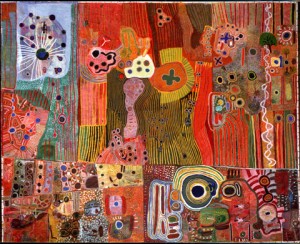
Following my earlier post about the possibility of a work of art being an argument, I want to give another example.  This example is also drawn from Australian aboriginal society, and involves a 1997 claim for legal title to land by the Ngurrara people over land in the Great Sandy Desert of Western Australia.  Frustrated by their inability to convince the Native Title Tribunal of their right to the land, the Ngurrara community decided to create a collaborative painting (photographed below) which would demonstrate their traditional rights. The painting was presented, and accepted, as evidence before the Tribunal and is therefore a work of argument, as well as a work of art.
Ngurrara II Canvas 1997
(The Ngurrara Canvas. Painted by Ngurrara artists and claimants, coordinated by Mangkaja Arts Resource Agency, May 1997. 10 metres x 8 metres. Photo: Mangkaja Arts Resource Agency.)
The case is mentioned in a 2003 New Yorker magazine article about aboriginal art by Geraldine Brooks, who says:

“In 1992, the Australian government first recognized the right of Aborigines to claim legal ownership of their ancestral lands – provided they could show evidence of having an enduring connection with them. Before proceeding to court, Aboriginal groups had to make their case before a Native Title Tribunal. Frustrated by their inability to articulate their arguments in courtroom English, the people of Fitzroy Crossing decided to paint their “evidence”. They would set down, on canvas, a document that would show how each person related to a particular area of the Great Sandy Desert – and to the long stories that had been passed down for generations.
“Ngurrara I”, the first attempt, was a canvas that measured sixteen feet by twenty-six feet and was worked on by nineteen artists. It was completed in 1996. But Skipper and Chuguna [two of the artists involved], in particular, didn’t feel that it properly reflected all the important places and stories, so more than forty additional artists were invited to produce a more definitive version. In 1997, “Ngurrara II”, which was twenty-six feet by thirty-two feet, was rolled out before a plenary session of the Native Title Tribunal. It was, one tribunal member said, the most eloquent and overwhelming evidence that had ever been produced there. The Aborigines could proceed to court.” (page 65).

 
References:
Geraldine Brooks [2003]: “The Painted Desert“, New Yorker, 28 July 2003, pp. 60-67.
Australian National Native Title Tribunal [2002]: Native Title Determination Summary – Marty and Ngurrara.  27 September 2002.  Background press release here.
Also, here is a transcript of a radio story (broadcast 1997-07-15) on Australian ABC radio about the submission of the painting as evidence to the Native Title Tribunal.
More on different forms of geographic knowledge here.

Step right up! Step right up!

Good morning and welcome to everyone who’s just arrived from Normblog!  Do come right in, and make yourself at home.  There are still seats up here near the front, and also over there by the poets.  (We apologize for the peanut shells some of the Beat poets left on the floor over there.)

Feel free to engage in an argument with us, especially regarding decision-theory or forecasting or even prophecy.  Although professionally we are interested in market planning and marketing strategy, we also have a special  interest in that hard-proving ground for data gathering, inference and complex reasoning, intelligence.  Indeed, some of our heroes worked in that arena, as well in politics and telecommunications and project management.  Eventually, though, even heroes become history.

What’s that? Oh, our tagline?  It’s from the opening of The Scalp Hunters: A Romance of Northern Mexico, by Captain Mayne Reid, published in 1860, and one of the young Teddy Roosevelt’s favourite books:

Unroll the world’s map, and look upon the great northern continent of America. Away to the wild west, away toward the setting sun, away beyond many a far meridian, let your eyes wander. Rest them where golden rivers rise among peaks that carry the eternal snow. Rest
them there.

So, browse around, stay as long as you wish, and do visit with us again when you have a free mo’.