Those of you paying attention to these lectures will realize how obsessed I am with Economics. That flaxen-haired lady promised so much, but she has so many flaws and failings. When we first meet her, it seems she is everything you could wish for: she is concerned with how society should be organized, how people should be given material goods, how the benefits of new technology and material well-being should be shared with all, and how the poor should be enriched, so that they can spend their time on self-improving and fulfilling activities, like art and sport. So much is promised!
But then, once the flirtation and seduction are over, her flaws become evident. I have been thinking about these flaws again, having just read Deirdre McCloskey’s superb 2002 pamphlet, The Secret Sins of Economics. Many of McCloskey’s criticisms are ones I (and many others) have made before, but some are new. I decided, for comparison, to list here my chief complaints with this blemished beauty, this feline seductress, Our Lady of the Catallacts. Date her if you wish, but you should read these accounts by her ex-lovers before you do.
First, she is blinkered, often unable to see what is obvious to anyone else – that we are all shaped by social and cultural forces, and peer pressures. Instead, Catwoman and her acolytes invariably assume an individualist explanation for any economic or social phenomenon, and then seek to demonstrate it. McCloskey calls this a focus on the P-variables (price, individual prudence, profit, the profane) as distinct from the S-variables (solidarity, speech, stories, shame) which Anthropology, that Indiana Jones of academic disciplines – creative, unruly, a thorn in everyone else’s side – has focused on. A classic example is Levitt and Dubner’s Freakonomics.
Because of her blindness to the social, Cat Lady mostly ignored (until recently) major aspects of society, such as Institutions, legal frameworks, norms, and power relationships, aspects which can make or fail the marketplaces she says she studies. She can’t claim that no one mentioned these to her, since 19th-century economists such as Karl Marx made the study of these aspects the work of a lifetime, and their study has continued to the present by sociologists and anthropologists and political scientists.
She has also been blind to anything historical or temporal, as if all her work stood outside the mundane and messy world in which we live. This blindness manifests itself most strongly in the complete disregard (until recently) for endowments: how did we get to where we are? So, for example, free trade theory says that if England produces textiles more cheaply than Portugal, and Portugal produces wine more cheaply then England, the two should trade textiles for wine, and wine for textiles. And the choice of these products is a subtly clever one, obfuscating much, since wine needs sunshine and not too much rain, while textiles (in the 18th and early 19th centuries) needed lots of rain, in order that the damp air would ensure cotton threads did not break when woven by machines. So, Portugal’s sunshine and Northern England’s rain, being part of the God-given climate, were natural advantages, beyond the control or manipulation of any temporal human powers. Free trade seems to have been ordained by the Almighty. But why consider only England’s textiles and not Ireland’s? The answer is that Ireland had no textile industry to speak of. And just why is that? After all, much of Ireland is as damp as the valleys of Lancashire. The reason is that the owners of northern English textile factories lobbied the British authorities to exclude Irish-made textiles from entering England. When Ireland lost its own Parliament in a hostile takeover by Westminster, this protectionism for English textiles was entrenched, and the growing British Empire provided the critical masses of customers to ensure bonuses in Bury and Bolton and Burnley. (Is it any wonder that people in Ireland and India and elsewhere sought Independence, when colonialism so powerfully stifled economic aspirations.) Northern England has no natural comparative advantage in textile production, at least, not when compared to Ireland, but an artificial, man-made advantage. The same type of advantage, in fact, that South Korea today has in ship-building, or the USA in most computer and aerospace technologies. Where, in the mainstream theory of free trade, are these aspects studied, or even mentioned?
And when, angered by these failings, you face her with them, the wench promises you that that was all in the past, and she will be different from now on. Path dependence and network goods and institutional economics are all the rage, she says. But then you find, she’s still up to her old tricks: She says she’s building models of economic phenomena in order to understand, predict and control, just like physicists do. But, although it looks like that’s what she’s doing, in fact her models are not models of real phenomena, but models of stylized abstractions of phenomena. Her acolytes even use that very word – stylized – to describe the “facts” which they use to calibrate or test their models.
Of course, she will say, physicists do this too. Newton famously assumed the planets were perfect spheres in order to predict their relative movements using his theory of gravitation. But physicists later relax their assumptions, in order to build revised models, in a process that has continued since Newton to the present day. Physicists also allow their models to be falsified by the data they collect, even when that data too is stylized, and overturned. Instead, Catwoman is still assuming that people are maximizers of individual utility, with perfect foresight and unlimited processing capabilities, obeying the axiom of the irrelevance of independent alternatives, when all these assumptions have been shown to be false about us. When was the last time a mainstream economic model was overturned?
Indeed, here is another of her flaws: her loose grasp of reality. She says we are always, all of us, acting in our own self-interest. When you quiz this, pointing out (say) a friend who donated money to a charity, she replies that he is making himself feel better by doing something he thinks virtuous, and thus is maximizing his own self-interest. Her assumption, it turns out, is unfalsifiable. It is also naive and morally repugnant – and false! Anyone with any experience of the world sees through this assumption straight away, which is why I think our feline friend is borderline autistic. She just does not know much about real people and how they interact and live in the word. Who would want to step out with someone having such views, and unable to reconstruct them in the light of experience?
And, despite her claims to be grounded in the material world (Paul Samuelson: “Economics is the study of how people and society end up choosing, with or without the use of money, to employ scarce productive resources that would have alternative uses, . . .”), she sure is fond of metaphysical entities for which no hard evidence exists: invisible hands, equilibria, perfect competition, free trade, commodities, in fact, the whole shebang. As marketers say, the existence of a true commodity is evidence that a marketing manager is not doing his or her job. In comparison, Richard Dawkins with his memes is a mere amateur in this creation of imaginary objects for religious veneration.
One could perhaps accept the scented candles and the imaginary friends if she was a little more humble and tolerant of the opinions of others. But no, the feline femme fatale and her acolytes are among the most arrogant and condescending of any academic disciplines. Read the recovering Chicago economist McCloskey for an account of this, if you don’t believe me. McCloskey’s anecdotes and experiences were very familiar to me, especially that sneer from an economist who thinks you’ve not acted in your own self-interest – for example, by helping your colleagues or employer with something you are not legally required to do. Indeed, the theft by economists from philosophers of the word “rational” to describe a very particular, narrow, autistic behavior is the best example of this. Anyone whose behavior does not fit the models of mainstream economics can be thus be labeled irrational, and dismissed from further consideration as if insane.
Date her at your peril! You have been warned!
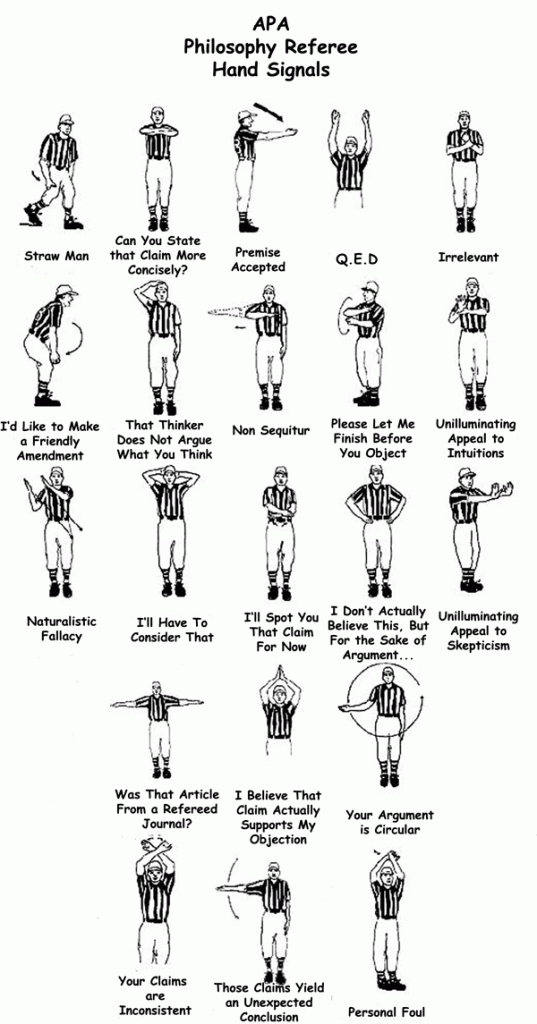
Argument mediation signals
Here are signals for argument mediators, for your next blog argument. (From here. HT: SP)
Vale: Robin Milner
The death has just occurred of Robin Milner (1934-2010), one of the founders of theoretical computer science. Milner was an ACM Turing Award winner and his main contributions were a formal theory of concurrent communicating processes and, more recently, a category-theoretic account of hyperlinks and embeddings, his so-called theory of bigraphs. As we move into an era where the dominant metaphor for computation is computing-as-interaction, the idea of concurrency has become increasingly important; however, understanding, modeling and managing it have proven to be among the most difficult conceptual problems in modern computer science. Alan Turing gave the world a simple mathematical model of computation as the sequential writing or erasing of characters on a linear tape under a read/write head, like a single strip of movie film passing back and forth through a projector. Despite the prevalence of the Internet and of ambient, ever-on, and ubiquitous computing, we still await a similar mathematical model of interaction and interacting processes. Milner’s work is a major contribution to developing such a model. In his bigraphs model, for example, one graph represents the links between entities while the other represents geographic proximity or organizational hierarchy.
Robin was an incredibly warm, generous and unprepossessing man. About seven years ago, without knowing him at all, I wrote to him inviting him to give an academic seminar; even though famous and retired, he responded positively, and was soon giving a very entertaining talk on bigraphs (a representation of which is on the blackboard behind him in the photo). He joined us for drinks in the pub afterwards, buying his round like everyone else, and chatting amicably with all, talking both about the war in Iraq and the problems of mathematical models based on pre-categories with a visitor from PennState. He always responded immediately to any of my occasional emails subsequently.
The London Times has an obituary here, and the Guardian here (from which the photo is borrowed).
References:
Robin Milner [1989]: Communication and Concurrency. Prentice Hall.
Robin Milner [1999]: Communicating and Mobile Systems: the Pi-Calculus. Cambridge University Press.
Robin Milner [2009]: The Space and Motion of Communicating Agents. Cambridge University Press.
Operational incompetence at CIA
At the end of December 2009, an Al Qaeda double agent killed himself and seven CIA agents and security staff at a US base in Khost, Afghanistan. Former CIA agent and writer, Robert Baer, has an account of the tragedy in a fascinating article in next month’s GQ, here. Baer argues, as he has before, that CIA management have systematically and deliberately destroyed the agency’s capabilities for human espionage – that field operations are devalued, that field operational skills are not taught, not learnt, and not acquired, that junior field staff are not mentored, and that field skills and experience are not rewarded within the agency. Organizational lack of attention to operational skills allowed a junior and field-inexperienced analyst to be appointed head of the Khost base, allowed that analyst to be appointed with neither knowledge of the local language nor prior local experience, allowed her to arrange a meeting with a human informant at the base (instead of off-base), allowed her to arrange a meeting with a human informant that no one locally had previously met, allowed numerous other people to attend this meeting, allowed this meeting to be discussed ahead of time back at Langley and in the White House, and allowed the informant to pass through three security checkpoints without being checked for weapons or bombs. They even baked a birthday cake for their visiting suicide bomber. The numbers killed made this the worst disaster for CIA since the 1983 bombing of the US Embassy in Beirut.
Retrospect, of course, is always wiser than prospect. But one has to wonder how low the level of espionage tradecraft could be that so many gross errors were made. Baer puts the blame squarely on the deprofessionalization of CIA’s field operations, especially since John Deutch’s time as Director (1995-1996).
At the end of his article, Baer says:
The United States still needs a civilian intelligence agency. (The military cannot be trusted to oversee all intelligence-gathering on its own.)”
In his memoirs, former US Defense Secretary Robert McNamara said that one lesson he’d learnt from the US military involvement in Vietnam was the need for an independent and objective source of intelligence on progress (eg, numbers and locations of enemy engagements; the outcomes of engagements; assessments of enemy strength and morale; etc). In Vietnam, this information was not provided to the White House by CIA or any other independent agency, but by the US military themselves, and was therefore subject to distortion, to bias, and to outright manipulation. The people firing the arrows were the same people drawing the targets for the arrows and counting how many bullseyes the archers had achieved.
A recent CNN interview with Robert Baer is here (conducted 2010-03-16).
A previous post which mentions Robert Baer is here.
Metrosexual competition
Writing about the macho world of pure mathematics (at least, in my experience, in analysis and group theory, less so in category theory and number theory, for example), led me to think that some academic disciplines seem hyper-competitive: physics, philosophy, and mainstream economics come to mind. A problem for economics is that the domain of the discipline includes the study of competition, and the macho, hyper-competitive nature of academic economists has led them, I believe, astray in their thinking about the marketplace competition they claim to be studying. They have assumed that their own nasty, bullying, dog-eat-dog world is a good model for the world of business.
If business were truly the self-interested, take-no-prisoners world of competition described in economics textbooks and assumed in mainstream economics, our lives would all be very different. Fortunately, our world is mostly not like this. One example is in telecommunications where companies compete and collaborate with each other at the same time, and often through the same business units. For instance, British Telecommunications and Vodafone are competitors (both directly in the same product categories and indirectly through partial substitutes such as fixed and mobile services), and collaborators, through the legally-required and commercially-sensible inter-connections of their respective networks. Indeed, for many years, each company was the other company’s largest customer, since the inter-connection of their networks means each company completes calls that originate on the other’s network; thus each company receives payments from the other.
Do you seek to drive your main competitor out of business when that competitor is also your largest customer? Would you do this, as stupid as it seems, knowing that your competitor could retaliate (perhaps pre-emptively!) by disconnecting your network or reducing the quality of your calls that interconnect? No rational business manager would do this, although perhaps an economist might.
Nor would you destroy your competitors when you and they are sharing physical infrastructure – co-locating switches in each other’s buildings, for example, or sharing rural cellular base stations, both of which are common in telecommunications. And, to complicate matters, large corporate customers of telecommunications companies increasingly want direct access to the telco’s own switches, leading to very porous boundaries between companies and their suppliers. Doctrines of nuclear warfare, such as mutually-assured destruction or iterated prisoners’ dilemma, are better models for this marketplace than the mainstream one-shot utility-maximizing models, in my opinion.
You might protest that telecommunications is a special case, since the product is a networked good – that is, one where a customer’s utility from a particular service may depend on the numbers of other customers also using the service. However, even for non-networked goods, the fact that business usually involves repeated interactions with the same group of people (and is decidely not a one-shot interaction) leads to more co-operation than is found in an economist’s philosophy.
The empirical studies of hedge funds undertaken by sociologist Donald MacKenzie, for example, showed the great extent to which hedge fund managers rely in their investment decisions on information they receive from their competitors. Because everyone hopes to come to work tomorrow and the day after, as well as today, there are strong incentives on people not to mis-use these networks through, for instance, disseminating false or explicitly-self-serving information.
It’s a dog-help-dog world out there!
Reference:
Iain Hardie and Donald MacKenzie [2007]: Assembling an economic actor: the agencement of a hedge fund. The Sociological Review, 55 (1): 57-80.
Mr Sculthorpe, please call your office
I was thinking recently about concert performances I have attended where the composer was present, or rather, where I knew the composer to be present. Here is my list, as best I remember it:
Don Banks (1923-1980)
Sally Beamish (Hover, London, 21 February 2024)
Richard Rodney Bennett (1936-2012)
Pierre Boulez (1925-2016)
Ann Carr-Boyd (Britannia Fanfare, 2012)
Barry Conyngham
Palle Dahlstedt
Jasper Eaglesfield (London, 13 June 2024)
David Fanshawe (1942-2010, African Sanctus, Liverpool)
Rolf Hind
Archie John (East China Sea, London, 7 June 2024)
Robin Holloway
Keith Humble (1927-1995)
Gerard McBurney
James MacMillan (premiere of “Precious in the sight of the Lord”, Mass for the Fourth Centenary Celebration of the British Society of Jesus, 21 January 2023)
Olivier Messiaen (1908-1992)
Stephen Montague (Piano Concerto, BBC Proms, London)
Nico Muhly (premiere of Electric Violin Concerto, performed by Thomas Gould, and premiere of opera, Two Boys, at ENO, London)
Olli Mustonen (playing his own Sonata for Violin and Piano with Pekka Kuusisto, London 2013)
Tristan Murail (Reflections/Reflets, performed by the BBSO under Sakari Oramo, London 2013)
Nicola Murphy (Wavelength, Brisbane, 29 August 2024)
Loretta Notareschi
Jim Penberthy (1917-1999)
Behzad Ranjbaran (premiere of Violin Concerto, performed by Joshua Bell)
Johannes X. Schachtner
Peter Sculthorpe (1929-2014)
Larry Sitsky
Toru Takemitsu (1930-1996)
David Urquhart-Jones
James Wishart
Iannis Xenakis (1922-2001)
Of course, my presence at a performance does not constitute an endorsement of the music performed: some of the music of these composers I like or appreciate very much, and some I think is unpleasant, boring or otherwise of low quality. Although I generally prefer downtown and minimalist music, the music of the composers listed here also includes neo-romanticism (eg, Holloway, late Sculthorpe), abstract expressionism (eg, Penberthy, early Sculthorpe, Takemitsu), and uptown complexity (eg, Boulez, Muhly, Xenakis). And, I have not included in this list jazz performers, who almost always play some of their own compositions.
For Peter Sculthorpe, one occasion (of several where we have both been present) was a performance in January 1975 near Patonga, Broken Bay, Sydney, of his profound and achingly-beautiful Sun Music III, in which I had the great good fortune, as second percussionist, to play the guiro. One has to wonder how the same person could compose the innovative Sun Music series of the 1960s and also the derivative, warmed-over, late-romantic tosh that Sculthorpe has written in recent years. Bill Burroughs would have seen it as a clear case of spirit possession.
POSTSCRIPT (2014-01-11): New Zealander Alannah Currie, of The Thompson Twins, plays a guiro in their hit Hold Me Now (1983). See video here.
Macho mathematicians
Pianist and writer Susan Tomes has just published a new book, Out of Silence, which the Guardian has excerpted here. This story drew my attention:
Afterwards, my husband and I reminisced about our attempts to learn tennis when we were young. I told him that my sisters and I used to go down to the public tennis courts in Portobello. We had probably never seen a professional tennis match; we just knew that tennis was about hitting the ball to and fro across the net. We had a few lessons and became quite good at leisurely rallies, hitting the ball back and forth without any attempt at speed. Sometimes we could keep our rallies going for quite a long time, and I found this enjoyable.
Then our tennis teacher explained that we should now learn to play “properly”. It was only then that I realised we were meant to hit the ball in such a way that the other person could not hit it back. This came as an unpleasant surprise. As soon as we started “playing properly”, our points became extremely short. One person served, the other could not hit it back, and that was the end of the point. It seemed to me that there was skill in hitting the ball so that the other person could hit it back. If they could, the ball would flow, one got to move about and there was not much interruption to the rhythm of play. It struck me that hitting the ball deliberately out of the other person’s reach was unsportsmanlike. When I tell my husband all this, he laughs and says: “There speaks a true chamber musician.”
This story resonated strongly with me. Earlier this year, I had a brief correspondence with mathematician Alexandre Borovik, who has been collecting accounts of childhood experiences of learning mathematics, both from mathematicians and from non-mathematicians. After seeing a discussion on his blog about the roles of puzzles and games in teaching mathematics to children, I had written to him:
Part of my anger & frustration at school was that so much of this subject that I loved, mathematics, was wasted on what I thought was frivolous or immoral applications: frivolous because of all those unrealistic puzzles, and immoral because of the emphasis on competition (Olympiads, chess, card games, gambling, etc). I had (and retain) a profound dislike of competition, and I don’t see why one always had to demonstrate one’s abilities by beating other people, rather than by collaborating with them. I believed that “playing music together”, rather than “playing sport against one another”, was a better metaphor for what I wanted to do in life, and as a mathematician.
Indeed, the macho competitiveness of much of pure mathematics struck me very strongly when I was an undergraduate student: I switched then to mathematical statistics because the teachers and students in that discipline were much less competitive towards one another. For a long time, I thought I was alone in this view, but I have since heard the same story from other people, including some prominent mathematicians. I know one famous category theorist who switched from analysis as a graduate student because the people there were too competitive, while the category theory people were more co-operative.
Perhaps the emphasis on puzzles & tricks is fine for some mathematicians – eg, Paul Erdos seems to have been motivated by puzzles and eager to solve particular problems. However, it is not fine for others — Alexander Grothendieck comes to mind as someone interested in abstract frameworks rather than puzzle-solving. Perhaps the research discipline of pure mathematics needs people of both types. If so, this is even more reason not to eliminate all the top-down thinkers by teaching only using puzzles at school.”
More on the two cultures of mathematics here.
The sources of silence
I listed here many of the teachers and thinkers whose influence I have felt. In his wonderful new book on John Cage’s 4′ 33”, the indefatigable Kyle Gann says this (pages 71-72):
The meme that Cage was more of a music philosopher than a composer has become commonplace, most of all, it seems, among people who don’t like his music and are in need of a way to justify his celebrity. Cage was not a philosopher in any sense that the philosophy profession would recognize, but he was very much a composer who drew inspiration for his music from philosophical ideas. The list of artists, writers, and thinkers he names in justification of his musical trajectory is a long one: Meister Eckhart, Huang-Po, Kwang-Tse, Erik Satie, Henry David Thoreau, Gertrude Stein, Arnold Schoenberg, John Cage Sr., Marcel Duchamp, Sri Ramakrishna, Daisetz Sukuki, Joseph Campbell, Ananda K. Coomaraswamy, Alan Watts, Antonin Artaud, Robert Rauschenberg, Morton Feldman, David Tudor, Norman O. Brown, Marshall McLuhan, Buckminster Fuller, Gita Sarabhai, and Christian Wolff, among others.”
I was reminded of James Pritchett’s intention, when writing his book on Cage’s music, to as much as possible read everything that John Cage had himself read, and in the order he had done so.
References:
Kyle Gann [2010]: No Such Thing as Silence. John Cage’s 4′ 33”. New Haven, CT, USA: Yale University Press.
James Pritchett [1993]: The Music of John Cage. Cambridge, UK: Cambridge University Press.
Revisionist history
The Australian Department of Defence has been accused of ignoring the religious beliefs of Australian soldiers killed in World War I currently being re-buried, by assuming they were all Christians. This assumption is a very odd one for the DoD to make, given that the first Australian-born commander of Australian troops, General Sir John Monash, in command of all Australian forces by the end of that war, promoted to General in the field, and knighted on the battlefield (the first such elevation by a British monarch in 200 years), was Jewish. I think the DoD needs to make a change in its burial policy and officially apologize to the affected families.
Memories of underdevelopment
Here is news from The Times about Robert Mugabe’s physiology. Apparently, he nods off to sleep every few minutes, even when meeting foreign visitors. (HT: Normblog)
The Times article mentions the two main contenders for the leadership of ZANU (PF) following Bob’s always-imminently-predicted-but-never-quite-arriving retirement: Emmerson Mnangagwa and Solomon Mujuru. One would think that the Zimbabwean Vice-President, Joice Mujuru, who is likewise a ZANU (PF) nomenklatura, would perhaps also be a contender, but she is married to Solomon, so he takes precedence. She is more famous in Zimbabwe under her chimurenga name, Teurai Ropa (or Spill-Blood) Nhongo, and for leading a team of guerrilla fighters into battle while pregnant. Because she joined the struggle (for Independence) in her teens, she did not finish high-school; to her great personal credit, she completed her O-levels after Independence and while a Cabinet Minister. In the year she did O-level English, a novel by George Orwell was on the syllabus, leading to her infamous stage whisper at the official opening by then Prime Minister Robert Mugabe of the Zimbabwe Institute for Development Studies; when the VIPs were led to a different (and much better) buffet than that provided for the other people present, she was heard by all to exclaim, “But this is just like Animal Farm!”
Her husband also had a loud voice. When I first met him, he was calling himself Rex Nhongo, and I did not then know what he looked like. A mutual friend introduced us using only first names as we happened upon each other buying groceries one evening after work in Twelve Gods, a foodstore and delicatessen in the low-density (ie, formerly whites-only) suburbs of Salisbury (as it then was). Making conversation while we stood in the queue, I asked, “And what do you do for a living, Rex?” In a booming voice which scared the living daylights out of the white customers in the shop, he replied, “Oh, I’m Commander-in-Chief of the Army, son!” Whether intended or not, this statement got the three of us to the front of the queue immediately. The mutual friend who introduced us is now himself a Cabinet Minister, one of the MDC contingent in Zimbabwe’s Cohabitation Government.
UPDATE [2011-09-12]: In August 2011, Rex Nhongo’s body was found after a fire destroyed his farmhouse. He was 62, and may have been killed or prevented from moving prior to the fire. The Guardian obituary is here.
FOOTNOTE:
Note that in maShona custom, a person may be given or may adopt different names over their life, and may prefer different names at different times or for different purposes. In addition, for reasons of security during the liberation struggle many people adopted noms de guerre, so-called chimurenga names.