Networks of Banks

The first plenary speaker at the 13th International Conference on E-Commerce (ICEC 2011) in Liverpool last week was Robert, Lord May, Professor of Ecology at Oxford University, former Chief UK Government Scientific Advisor, and former President of the Royal Society.  His talk was part of the special session on Robustness and Reliability of Electronic Marketplaces (RREM 2011), and it was insightful, provocative and amusing.
May began life as an applied mathematician and theoretical physicist (in the Sydney University Physics department of Harry Messel), then applied his models to food webs in ecology, and now finds the same types of network and lattice models useful for understanding inter-dependencies in networks of banks.  Although, as he said in his talk, these models are very simplified, to the point of being toy models, they still have the power to demonstrate unexpected outcomes:  For example, that actions which are individually rational may not be desirable from the perspective of a system containing those individuals.  (It is one of the profound differences between Computer Science and Economics, that such an outcome would be unlikely to be surprising to most computer scientists, yet seems to be so to mainstream Economists, imbued with a belief in metaphysical carpal entities.)
From the final section of Haldane and May (2011):

The analytic model outlined earlier demonstrates that the topology of the financial sector’s balance sheet has fundamental implications for the state and dynamics of systemic risk. From a public policy perspective, two topological features are key.
First, diversity across the financial system. In the run-up to the crisis, and in the pursuit of diversification, banks’ balance sheets and risk management systems became increasingly homogenous. For example, banks became increasingly reliant on wholesale funding on the liabilities side of the balance sheet; in structured credit on the assets side of their balance sheet; and managed the resulting risks using the same value-at-risk models. This desire for diversification was individually rational from a risk perspective. But it came at the expense of lower diversity across the system as whole, thereby increasing systemic risk. Homogeneity bred fragility (N. Beale and colleagues, manuscript in preparation).
In regulating the financial system, little effort has as yet been put into assessing the system-wide characteristics of the network, such as the diversity of its aggregate balance sheet and risk management models. Even less effort has been put into providing regulatory incentives to promote diversity of balance sheet structures, business models and risk management systems. In rebuilding and maintaining the financial system, this systemic diversity objective should probably be given much greater prominence by the regulatory community.
Second, modularity within the financial system. The structure of many non-financial networks is explicitly and intentionally modular.  This includes the design of personal computers and the world wide web and the management of forests and utility grids. Modular configurations prevent contagion infecting the whole network in the event of nodal failure. By limiting the potential for cascades, modularity protects the systemic resilience of both natural and constructed networks.
The same principles apply in banking. That is why there is an ongoing debate on the merits of splitting banks, either to limit their size (to curtail the strength of cascades following failure) or to limit their activities (to curtail the potential for cross-contamination within firms). The recently proposed Volcker rule in the United States, quarantining risky hedge fund, private equity and proprietary trading activity from other areas of banking business, is one example of modularity in practice. In the United Kingdom, the new government have recently set up a Royal Commission to investigate the case for encouraging modularity and diversity in banking ecosystems, as a means of buttressing systemic resilience.
It took a generation for ecological models to adapt. The same is likely to be true of banking and finance.”

It would be interesting to consider network models which are more realistic than these toy versions, for instance, with nodes representing banks with goals, preferences and beliefs.
 
References:
F. Caccioli, M. Marsili and P. Vivo [2009]: Eroding market stability by proliferation of financial instruments. The European Physical Journal B, 71: 467–479.
Andrew Haldane and Robert May [2011]: Systemic risk in banking ecosystems. Nature, 469:  351-355.
Robert May, Simon Levin and George Sugihara [2008]: Complex systems: ecology for bankers. Nature, 451, 893–895.
Also, the UK Government’s 2011 Foresight Programme on the Future of Computer Trading in Financial Markets has published its background and working papers, here.
 

Biedermeier Orientalism


Listening to Mendelssohn’s Auf Flugeln des Gesanges (“On Wings of Song”), a setting of a poem by Heinrich Heine, I am reminded of the composer’s orientalism.    The poem expresses a deep interest in orientalist thought; indeed, the words are quite remarkable for their cosmopolitan and surrealist flavour.

Mendelssohn was well-read in Asian thought, particularly Hindu and Sufist philosophy, and was close friends with Friedrich Rosen (1805-1837), an orientalist and first Professor of Sanskrit at University College London (appointed at age 22).  In his letters, too, Mendelssohn recommended to his brother Paul a book of Eastern mystic aphorisms by another orientalist, Friedrich Ruckert, saying this book, (“Erbauliches und Beschauliches aus dem Morgenlande” – Establishments and Contemplations from the Orient),  provided “delight beyond measure” (Letter of 7 February 1840).    (At roughly the same time, of course, Thoreau and the other New England Transcendentalists were also being strongly influenced by orientalist ideas and literature.)  Mendelssohn was well-read in theology and philosophy generally, and particularly influenced by the ideas of Friedrich Schleiermacher. There is something more profound here in Mendelssohn’s thought and music than is usually noticed by people who dismiss his music (and often Biedermeier culture generally) as being lightweight and superficial.   That an activity is inward-focused does not make it light or superficial; indeed, the reverse is usually true.

Among the more there that is here, I believe, is a relationship between Sufist ideas and Mendelssohn’s love of repetition, something one soon hears in his melodies with their many repeated notes.  A similar relationship exists between JS Bach’s fascination with Pietism, and his own love of repetition, as in the first movement of the D Minor Piano Concerto (BWV 1052), or the proto-minimalism of, for example, Prelude #2 in C minor, in Book 1 of the 48 (The Well-Tempered Clavier).

Those dismissing Mendelssohn for being superficial included, famously, Richard Wagner, whose criticisms were certainly motivated by anti-semitism, jealousy, and personal animosity.  But I wonder, too, if Wagner – that revolutionary of ’48 – was also dismissive of what he perceived to be the inward-focus of the Biedermeier generation, a generation forced to forego public political expression in the reimposition of conservative Imperial rule after the freedoms wrought by Napoleon’s armies.    But not speaking one’s political mind in public is not evidence of having no political mind, as any post-war Eastern European could tell you.  While visiting Paris in the 1820s, Mendelssohn attended sessions of the French National Assembly.  While in London in 1833, he attended the House of Commons to observe the debate and passage of the bill to allow for Jewish emancipation, writing excitedly home about this afterwards.  (Sadly, the bill took another three decades to pass the Lords.)

In July 1844, while again in London, Mendelssohn was invited to receive an Honorary degree from Trinity College Dublin, and hearing that he would be going to Dublin, Morgan O’Connell, son of Irish nationalist Daniel O’Connell, asked him to take a letter to his uncle, then in a Dublin prison.  (As it happened, Mendelssohn was unable to go to Ireland on that occasion.  See: letter to his brother Paul, 19 July 1844, page 338 of Volume 2 of Collected Letters.)   One wonders how O’Connell could ask of someone such a favour, without first knowing something of the man’s political sympathies.  So perhaps those sympathies were radical, anti-colonial and republican. In an earlier letter, Mendelssohn described standing amidst British nobility with his “citizen heart” in an audience at the Court of Victoria and Albert (Letter of 6 October 1831).  As these incidents reveal, there may have been much more to this Biedermeier mister than meets the eye.

Vale Robert Oakeshott

The Guardian today carries an obituary for Robert Oakeshott (1933-2011), pioneer of worker-cooperatives and employee-owned enterprises, whom I once invited to speak at the University of Zimbabwe and with whom I then spent an enjoyable dinner in Harare, at a time when the Government of Zimbabwe was sincerely promoting industrial and agricultural worker co-operatives, supported by many western aid donor agencies.

East of my day's circle

I have written before about Robert Southwell SJ, poet, martyr and Shakespeare’s cousin, and quoted some of his poems.  Southwell (c. 1561-1595) was an English Jesuit from an aristocratic family, whose mother had been a governess and friend of Queen Elizabeth I.  He left England illegally to study for the priesthood and returned — again illegally — to live and minister in secret to England’s oppressed Catholic population.  He was captured, tortured by Elizabeth’s sadistic religious police, subjected to a show trial, and publicly executed.
Southwell was a poet of fine sensitivity, and drew on his Jesuit spiritual training to become the first English poet to develop personation (or subjectivity), a psychologically-real description of the interior self.   His cousin Will Shakespeare was to adopt this idea in his poetry and plays, so that (for example) we learn about Hamlet’s internal mental deliberations, not only about his public actions and conversations.  The late Anne Sweeney argued that Southwell developed personation in his poetry as a direct result of completing the Spiritual Exercises of St. Ignatius Lopez of Loyala, a process of meditation and self-reflection which all Jesuits undertake. In her words (p. 80):

The core experience of the Ignatian Exercises was the reading and learning of the hidden self, the exercisant learning to define his reponses according to a Christian morality that would then moderate his behaviour. After a powerfully imagined involvement in, say, Christ’s birth, he was required to withdraw the mind’s eye from the scene before him and redirect it into himself to analyse with care the feelings thereby aroused.”

It would be interesting to know if Ignatius himself drew on literary models from (eg) Basque, Catalan or Spanish in devising the Exercises.

Living underground and on the run, Southwell wrote poetry for a community unable to obtain prayer books or to easily hear preachers;  poetry was thus a substitute for sermons and for personal spiritual counselling, and a form of prayer and spiritual meditation.  His poetry is also strongly visual.
Because the Jesuit mission to England during Elizabeth’s reign was forced underground it is not surprising that Jesuit priests mostly lived in the homes of rich or noble Catholics, or Catholic sympathizers, sometimes hidden in secret chambers.    It is more surprising that there were still English nobles willing to risk everything (their wealth, their titles, their freedom, their homeland, their lives) to hide these priests.   One such family was that of Philip Howard, the 20th Earl of Arundel (1557-1595), who was 10 years a prisoner of Elizabeth I, refusing to recant Catholicism, and who died in prison without ever meeting his own son.   Howard’s wife, Anne Dacre (1557-1630), was also a staunch Catholic.  The earldom of Arundel is the oldest extant earldom in the English peerage, dating from 1138.
The Howard’s London house on the Thames was one of the noble houses which sheltered Robert Southwell for several years.    The location of their home, between the present-day Australian High Commission and Temple Tube station,  is commemorated in the names of streets and buildings in the area:  Arundel Street, Surrey Street, Maltravers Street (all names associated with the Arundel family), Arundel House, Arundel Great Court Building, the former Swissotel Howard Hotel, and the former Norfolk Hotel (now the Norfolk Building in King’s College London) in Surrey Street.    Maltravers Street is currently the location for a nightly mobile soup kitchen.   Of course, in Elizabethan times the Thames was wider here, the Embankment only being built in the 19th century.   One can still find steps in some of the side streets leading to the Thames descending at the edge where the previous riverbank used to be, for instance on Milford Lane.
Southwell also, it seems, spent time in the London house of his cousin Henry Wriothesley, 3rd Earl of Southampton (1573-1624), who was also Shakespeare’s patron and cousin.    Southampton’s house then was a short walk away, in modern-day Chancery Lane, on the east side of Lincoln’s Inn fields.   Southampton was part of the rebellion of Robert Deveraux, 2nd Earl of Essex (1565-1601) against Elizabeth in February 1601. The London house of Essex was also along the Thames, downstream and adjacent to that of the Howard family.  The street names there also recall this history:  Essex Street, Devereaux Court.
Supporters of Essex, chiefly brothers of Henry Percy, 9th Earl of Northumberland (1564-1632), paid for a performance of Shakespeare’s play, Richard II, the evening before the rebellion.   Percy was married to Dorothy Devereaux (1564-1619), sister of Robert, and was regarded as a Catholic sympathizer.  Percy also employed Thomas Harriott (1560-1621), a member of the matherati. Given the physical proximity of these noble villas, it is likely too that Southwell and Harriott met and knew each other.
And, weirdly, Essex and Norfolk are adjacent streets in the Lower East Side of Manhattan, too (close by and parallel to Orchard Street).
References:
The image is Shown a plan of Arundel House, the London home of the Earls of Arundel, as it was in 1792 (from the British Library).  The church shown in the upper right corner is St. Clement Danes, now the home church of the Royal Air Force.
Christopher Devlin [1956]: The Life of Robert Southwell: Poet and Martyr.  New York, NY, USA:  Farrar, Straus and Cudahy.
Robert Southwell [2007]:  Collected Poems. Edited by Peter Davidson and Anne Sweeney.  Manchester, UK:  Fyfield Books.
Anne R. Sweeney [2006]: Robert Southwell: Snow in Arcadia:  Redrawing the English Lyric Landscape 1586-1595. Manchester, UK:  Manchester University Press.

The Matherati: Index

The psychologist Howard Gardner identified nine distinct types of human intelligence. It is perhaps not surprising that people with great verbal and linguistic dexterity have long had a word to describe themselves, the Literati. Those of us with mathematical and logical reasoning capabilities I have therefore been calling the Matherati, defined here. I have tried to salute members of this group as I recall or encounter them.

This page lists the people I have currently written about or mentioned, in alpha order:
Alexander d’Arblay, John Aris, John Atkinson, John Bennett, Christophe Bertrand, Matthew Piers Watt Boulton, Joan Burchardt, David Caminer, Boris N. Delone, the Delone family, Nicolas Fatio de Duillier, Michael Dummett, Sean Eberhard, Edward FrenkelMartin Gardner, Kurt Godel, Charles Hamblin, Thomas Harriott, Martin Harvey, Fritz JohnErnest Kaye, Robert May, Robin Milner, Isaac NewtonHenri PoincareMervyn Pragnell, Malcolm Rennie, Dennis Ritchie, Ibn Sina, Adam Spencer, Bella Subbotovskaya, Bill Thurston, Alan Turing, Alexander Yessenin-Volpin.

And lists:
20th-Century Mathematicians.

Shakespeare's cousins

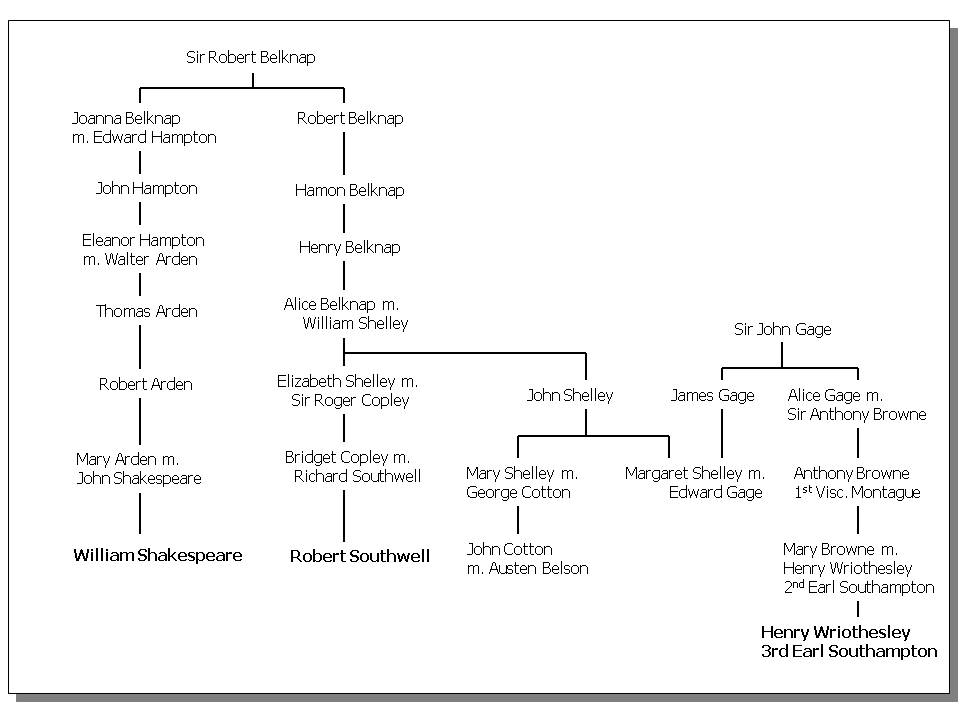
I have remarked before that whoever wrote William Shakespeare’s plays and poetry was deeply familiar with the poetry and prose of Robert Southwell SJ, and had access to Southwell’s works in manuscript form.  We know this because most of Southwell’s output was only published after his execution in 1595, and Shakespeare’s poetry shows Southwell’s influence well before this date.

Shakespeare and Southwell were cousins, and both were also cousins to Henry Wriothesley, third Earl of Southampton, Shakespeare’s patron and the likely dedicatee of the Sonnets.  John Klause, in his fine book tracing the influence of Southwell’s writing on Shakespeare’s own words, includes a family tree showing the family connections between these three Elizabethans.  I reproduce some of the tree below, copied from page 40 of Klause’s book. Southwell’s mother, Bridget Copley, was a governess to the young Princess Elizabeth, so the connections to the royal family were close. In addition, Southwell and Shakespeare were also connected through the Vaux and Throckmorton families (Devlin has another family tree, page 264).  

And the family connection between Southwell and Wriothesley was in fact closer than Klause’s tree indicates. Southwell’s eldest brother Richard married Alice Cornwallis, a niece of Henry Wriothesley senior, second Earl of Southampton and the third Earl’s father, and Southwell’s eldest sister Elizabeth married a nephew of the same second earl, a son of Margaret Wriothesley and Michael Lister.  Thus, Robert Southwell was twice a second cousin by marriage to Henry Wriothesley junior, third Earl (Devlin tree, p. 15).

References:
Christopher Devlin [1956]: The Life of Robert Southwell: Poet and Martyr.  New York, NY, USA:  Farrar, Straus and Cudahy.
John Klause [2008]: Shakespeare, the Earl, and the Jesuit. Teaneck, NJ, USA: Fairleigh Dickinson University Press.

Roughshod Riders

One annoying feature of the verbal commentariat is their general lack of real-world business experience.  A fine example has just been provided by political blogger Marbury, who derides Gordon Brown for not asserting himself when Prime Minister over his Cabinet Secretary on the matter of an enquiry into voicemail hacking at certain newspapers.
Well, to be fair to Gordon Brown, Marbury has clearly never led an organization and tried to force the people below him to do something they adamantly oppose doing.  No doubt, Brown when PM could have ordered the Cabinet Secretary to implement a public enquiry, but every single person in the chain of command could then have: (a) leaked the CabSec’s advice opposing the instruction, and/or (b) exercised their pocket veto to delay or prevent the enquiry happening, and/or (c) implemented it in a way which backfired upon Brown and the Cabinet. No rational manager tries to execute a policy his own staff vehemently oppose, even when, as appears to be the case here, he knows he has morality, the law, good governance, and the public interest all on his side.

Bill Mansfield RIP

A belated tribute to Bill Mansfield (1942-2011), Australian trade unionist, ACTU official and Industrial Relations Commission judge, who died earlier this year.   Elected federal secretary of the Australian Telecommunications Employees Association (ATEA), the main union of technical telecommunications staff, at a young age in 1977, Mansfield was one of a generation of Australian union leaders who were progressive, modern, reasonable, anti-Luddite, and very intelligent.    I had the good fortune to meet him and to hear him speak on several occasions, once at a seminar on the drivers and consequences of technological change;  it was clear that most managements would be out-smarted by him, and many foiled by his integrity, his willingness to engage in reasoned argument, and his integrity-of-purpose.  In the 1970s, the ATEA and its fellow communications unions ran a long-running and ultimately successful campaign seeking to get the management of Telstra (as the organization is now called) merely to have discussions with the unions about new technologies, their impacts, and their deployment; it was indicative of the belligerent stupidity of the management of the time that they sought to introduce new technologies without prior discussion with the affected workforce because management feared the workforce would be opposed.
There are tributes to him from his ACTU colleagues here and from Senator Doug Cameron here.

Charlotte Joko Beck RIP

A sad post to note the passing on of Charlotte Joko Beck (1917-2011), musician and Zen teacher.   Her books, full of practical wisdom and psychological insight, have been constant companions, as I alluded here.

Connections, south of my days

I have previously posted Judith Wright’s famous poem South of My Days, here.  For anyone growing up in rural eastern Australia, this poem with its stories of the great cattle droves of the late 19th and early 20th century resonates.

The SMH recently carried an obituary for John Atkinson (1940-2011), a mechanical engineering lecturer at Sydney University and member of the Matherati.  Atkinson’s mother, Gwen Wilkins, had been a university friend of Judith Wright (1915-2000) at Sydney University in the 1930s.  Atkinson’s father Tom managed a cattle station in Southern Queensland for Wright’s father, Phillip, and Judith apparently introduced Atkinson’s parents to each other.

This long-ago connection of farming families reminded me of the 50th anniversary commemoration of the Stinson aircrash in the remote and treacherous sub-tropical jungles of the Lamington Ranges National Park in Southern Queensland in February 1937, a commemoration I attended. The crash was the occasion of a famous rescue by bushman, Bernard O’Reilly, trekking alone on a hunch, recounted on the O’Reilly Guest House site here.

My father, with me that day in 1987, was surprised to encounter a work colleague also present.  It turned out that the O’Reilly family had farmed in the Kanimbla Valley in the Blue Mountains in central NSW, on a property adjoining my father’s colleague’s family property, before moving up to the McPherson Ranges in 1911.  Despite the distance (about 600 miles) and the remoteness of both locations, the two families had kept in touch through the intervening 76 years, with each new generation becoming friends.

O’Reilly wrote a famous book about his pioneering bush experiences and the Stinson rescue.  Among those I met that day were members of the rescue party that O’Reilly gathered together in 1937.

POSTSCRIPT (2011-12-23):  I remembered that Judith Wright wrote a poem about James Westray, who initially survived the Stinson crash. I have posted the poem here.

References:
Bernard O’Reilly [1940]:  Green Mountains.  Brisbane, Australia.

The report and documents of the official Queensland Government Inquest into the Stinson crash are here.

A remembrance of John Atkinson by a bush-walking friend is here.  Apparently, Dr Atkinson drowned in the surf.