Awhile back, I posted some advice from my own experiences on doing a PhD. Since then, several people have asked me for advice about the viva voce (or oral) examination, which most PhD programs require at the end of the degree. Here are some notes I wrote for a candidate recently.
It is helpful to think about the goals of the examiners. In my opinion, they are trying to achieve the following goals:
1. First, they simply want to understand what your dissertation says. This means they will usually ask you to clarify or explain things which are not clear to them.
2. Then, they want to understand the context of the work. This refers to the previous academic literature on the subject or on related subjects, so they will generally ask about that literature. They may consider some topic to be related to your work which you did not cover; in that case, you would normally be asked to add some text on that topic.
3. They want to assess if the work makes a contribution to the related literature. So they will ask what is new or original in your dissertation, and why it is different from the past work of others. They will also want to be able to separate what is original from what came before (which is sometimes hard to do in some dissertations, due to the writing style of the candidate or the structure of the document). To the extent that Computer Science is an engineering discipline, and thus involves design, originality is usually not a problem: few other people will be working in the same area as you, and none of them would have made precisely the same sequences of design choices in the same order for the same reasons as you did.
4. They will usually want to assess if the new parts in the dissertation are significant or important. They will ask you about the strengths and weaknesses of your research, relative to the past work of others. They will usually ask about potential future work, the new questions that arise from your work, or the research that your work or your techniques make possible. Research or research techniques which open up new research vistas or new application domains are usually looked upon favourably.
5. Goals #3 and #4 will help the examiners decide if the written dissertation is worth receiving a PhD award, since most university regulations require PhD dissertations to present an original and significant contribution to knowledge.
6. The examiners will also want to assess if YOU yourself wrote the document. They will therefore ask you about the document, what your definitions are, where things are, why you have done certain things and not others, why you have made certain design choices and not others, etc. Some examiners will even give the impression that they have not read your dissertation, precisely to find out if you have!
7. Every dissertation makes some claims (your “theses”). The examiners will generally approach these claims with great scepticism, questioning and challenging you, contesting your responses and arguments, and generally trying to argue you down. They want to see if you can argue in favour of your claims, to see if you are able to justify and support your claims, and how you handle criticism. After all, if you can’t support your claims, no one else will, since you are the one proposing them.
The viva is not a test of memory, so you can take a copy of your thesis with you and refer to it as you wish. Likewise, you can take any notes you want. The viva is also not a test of speed-thinking, so you can take your time to answer questions or to respond to comments. You can ask the examiners to explain any question or any comment which you don’t understand. It is OK to argue with the examiners (in some sense, it is expected), but not to get personal in argument or to lose your temper.
The viva is one of the few occasions in a research career when you can have an extended discussion about your research with people interested in the topic who have actually read your work. Look forward to it, and enjoy it!
Your local neighbourhood top-secret Global Military Command Centre
In WW II, the British military paid friendly nationals in neutral Sweden, Switzerland, and elsewhere to subscribe to provincial German newspapers in order to garner intelligence about life in Germany. Among other things, printed death notices were used to estimate casualty numbers in German military units, since particular units tended to recruit from particular regions; casualty rates were a means to assess the degree of success of Nazi military campaigns those units were involved in.
Let us hope now that Britain’s enemies are not reading provincial newspapers such as The Wiltshire Times (14 June 2011):
It is hard to believe that the central communications hub for the entire British Army sits unassumingly on the outskirts of the quiet Wiltshire market town of Corsham.
. . .
The centre, at Westwells Road, in Neston, is home to GOSCC – the Global Operations Security Control Centre – a top secret centre which houses up to 600 specialists working behind the scenes to make huge military operations such as those in Libya, Afghanistan and Iraq a reality.”
I guess not revealing the street number keeps the location of the top-secret centre safe.
Feats of memorization
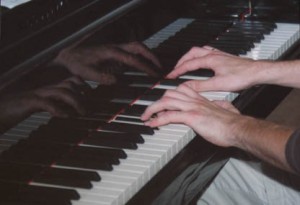
Anthony Tommasini writes in the IHT on the trend to allow concert pianists to play from music, instead of playing recital solos and concertos from memory. A good thing too! While playing from memory is an impressive feat to watch, it certainly takes additional practice effort to achieve: I would rather good performers played more different music than that they played a smaller collection from memory.
I saw Angela Hewitt play the Bach 48 from memory in Cottonopolis a few years ago. At the first concert, a woman in the front row was reading from a miniature score. After the first few preludes and fugues, Ms Hewitt quietly asked the woman to put her score away, as the page turning was distracting. My guess is that the page-breaks were happening at places other than where Ms Hewitt had memorized. (As an aside, her performance was very good but her interpretations undermined by rubato. I prefer my Bach straight, not with flavoured mixers.)
Note: The hands shown are those of Szabo Daniel.
Glasperlenspielen
Lars Pålsson Syll on “orthodox, mainstream, neoclassical economics”:
Economic theory today consists mainly in investigating economic models.
Neoclassical economics has since long given up on the real world and contents itself with proving things about thought up worlds. Empirical evidence only plays a minor role in economic theory (cf. Hausman [1997]), where models largely functions as a substitute for empirical evidence. But “facts kick”, as Gunnar Myrdal used to say. Hopefully humbled by the manifest failure of its theoretical pretences, the one-sided, almost religious, insistence on mathematical deductivist modeling as the only scientific activity worthy of pursuing in economics will give way to methodological pluralism based on ontological considerations rather than formalistic tractability.
If not, we will have to keep on wondering – with Robert Solow and other thoughtful persons – what planet the economic theoretician is on.” [page 54]
I agree with the general thrust of this essay, which resonates with some of my own thoughts on the Glass Bead Game of Economics, for example, here and here.
Mind you, I don’t agree with everything that Syll says in this essay. For example, he argues that good predictive capabilities require models to bear resemblance to their target domains. But we know many counter-examples to this claim, from Newton’s model of planetary motion to Friedman’s billiard players. Prediction and explanation are two orthogonal dimensions of a model, which may or may not be related in any particular case.
His essay also overlooks the fact that the so-called “real world” which is the target domain of economic models contains, at least in the case of macro-economics, mostly humanly-constructed artefacts, such as the “variables” known as inflation and unemployment rates. Having sat in working parties defining and redefining such artefacts, I am always surprised that any economist could possibly imagine they are modeling an independent reality.
Reference:
Lars Pålsson Syll [2010]: What is (wrong with) economic theory? Real-world Economics Review, 55: 23-57.
Shackle on Rational Expectations
The Rational Expectations model in economics assumes that each economic agent (whether an individual or a company) can predict the future as perfectly as the modelers themselves. To anyone living outside the rarified bubble of mathematical economics, this is simply ridiculous. It is clear that no one associated with that theory has ever made any real business decisions, or suffered their consequences.
Here is non-mainstream economist George Shackle, writing to Bryan Hopkins on 1980-08-20:
‘Rational expectations’ remains for me a sort of monster living in a cave. I have never ventured into the cave to see what he is like, but I am always uneasily aware that he may come out and eat me. If you will allow me to stir the cauldron of mixed metaphors with a real flourish, I shall suggest that ‘rational expectations’ is neo-classical theory clutching at the last straw.
Observable circumstances offer us suggestions as to what may be the sequel of this act or that one. How can we know what invisible circumstances may take effect in time-to come, of which no hint can now be gained? I take it that ‘rational expectations’ assumes that we can work out what will happen as a consequence of this or that course of action. I should rather say that at most we can hope to set bounds to what can happen, at best and at worst, within a stated length of time from ‘the present’, and can invent an endless diversity of possibilities lying between them. [Italics in original]
Of course, unlike John Muth or Robert Lucas, Shackle had actual real-world experience of investment decision-making from his experience during WW II on national infrastructure planning.
Reference:
George L. S. Shackle [1980]: Letter to Bryan Hopkins. Quoted in: Stephen L. Littlechild [2003]: Reflections on George Shackle: Three Excerpts from the Shackle Collection. The Review of Austrian Economics, 16 (1): 113-117.
Transitions 2012
Some who have passed on during 2012 whose life or works have influenced me:
- Graeme Bell (1914-2012), Australian jazz band leader
- Richard Rodney Bennett (1936-2012), British-American musician (heard perform in Canberra in 1976)
- Dave Brubeck (1920-2012), American musician (heard perform in Liverpool in ca. 2003)
- Arthur Chaskalson CJ (1931-2012), South African lawyer and judge
- Heidi Holland (1947-2012), Zimbabwean-South African writer
- Robert Hughes (1938-2012), Australian artist and art critic
- Oscar Niemeyer (1907-2012), Brazilian architect
- Bill Thurston (1946-2012), American mathematician
- Ruth Wajnryb (1948-2012), Australian linguist.
Eric the Red
Journalist Neal Ascherson recounts his first encounter with historian Eric Hobsbawm, who publicly insulted him as a new undergraduate at King’s College Cambridge in the early 1950s before Hobsbawm apparently even knew his name:
I lurched up a dark wooden stairway into a room full of chattering, laughing young men (no women, I noticed) and was handed more wine. Presently a lean, bespectacled man with fairish hair came over to me, with a few students drifting up behind him. One of them I vaguely recognised, an American, but I didn’t know his name.
Eric inspected me. A specimen, indeed.
“What’s that medal affair you’re wearing?”
“It’s my national service campaign medal. For active service in the Malayan emergency.”
Eric pulled back and took another look at me. Then he said, very sharply but without violence: “Malaya? You should be ashamed to be wearing that.”
I don’t think I said anything at all. I remember noticing the students around us, round-eyed with shock. Then I left the room, stumbling back down the dusky stairs, and out into the huge court where it was beginning to rain.
And the American? Daniel Ellsberg! Of course it was. Of course.
I am reminded of that old joke about time being God’s way of preventing everything happening at once, while space is His way of preventing everything happening at Cambridge.
Famous first words
The Spectator magazine recently ran a competition asking for the opening paragraph of an imagined sequel to a famous novel. One amusing entry, by Bill Greenwell, explained itself in just the first sentence:
Call me Moby. Many moons ago — I have no idea how many — and having nothing better to do than bite off the leg of a raving lunatic, and head-butt a strange wooden contraption that was chasing me, I resolved to mooch across the expanse that I alone inhabit, singing a variety of sonic compositions. You may, doubtless, imagine my surprise when a lascivious invitation reached me from afar, together with jolly explanations of how I might beget another in my own likeness. Ah! that explained the sensation of longing deep within me, and the purpose of my mysterious, extensible truncheon. I accounted it my destiny to manoeuvre my belly that I might raise a modest family, one single offspring — and in so doing, discredit the monstrous accounts of my fellow creatures (for so they are) who sought to rope and pierce me. I would have a man of a time.
Bill Greenwell/Moby-Dick
Recent Reading 6
The latest in a sequence of lists of recently-read books:
- Patricia Anderson [2009]: Robert Hughes: The Australian Years. (Sydney, Australia: Pandora Press.) A fascinating account of Robert Hughes’ time in Australia before his permanent departure abroad in the middle 1960s, sadly undermined by very poor organization, poor writing, and sloppy editing. Where was the editor when we learn of a 1958 play written by Hughes, in which the lead “roll” in 1959 is acted by an undergraduate John Bell (p.68)? And where again when Major Harold Rubin, wounded in WW I, is “invalidated” from the army (p. 116)? But the worst offence against the reader is the book’s poor organization. Each chapter begins afresh, as if each was a separate attempt to dissect Hughes and his circle, sometimes ignoring what we’d read in earlier chapters, and sometimes assuming we’ve already read to the end the book (or we know what he did with his life afterwards). A new viewpoint per chapter is not an intrinsically bad way to organize such material, but this attempt is poorly done, as if the writer or publisher had decided to skip the editing stage. The book embodies a promising idea undermined by poor execution.
- Rupert Sheldrake [2012]: The Science Delusion: Freeing the Spirit of Enquiry. (London, UK: Coronet.) This is a superb book, from one of the great scientific thinkers of our age. That Sheldrake is not so regarded by many other scientists is indicative of the closed-mindedness of contemporary science, much of it as dogmatic and un-sceptical as any religious cult. The grand foundation of myth of western science is that every claim and assumption is open to contestation, and by anyone, but the actual practice of most modern science is profoundly opposite to such openness. This book should be compulsory reading by every trainee, practising, and retired scientist.
- Robert Holmes [2012]: A Spy Like No Other: The Cuban Missile Crisis and the KGB Links to the Kennedy Assassination. (UK: Biteback Publishing). This book was most disappointing. The author has no evidence for his claim that Lee Harvey Oswald was a KGB agent, not even circumstantial evidence. His claim is based only the thinnest of speculation, about what some KGB people might have been doing talking with certain people they may have met at certain places they may have been visiting for certain purposes they may have had. In addition, it is sad to report that someone could write a book about the Kennedy assassination without being familiar with much of the contested nature of the evidence on the ancillary events. Thus, we know that someone calling himself Lee Harvey Oswald visited the Soviet Embassy in Mexico City shortly before JFK’s assassination. We don’t know for certain that this person was the Lee Harvey Oswald arrested in Dallas for that assassination. Without that certainty, the main evidence for Holmes’ claim falls away.
- Vladislav Zubok [2011]: Zhivago’s Children: The Last Russian Intelligentsia. (Cambridge, MA, USA: Harvard University Press). This is a fascinating and well-written cultural history of the Soviet shestidesiatniki, the people of the 60s, and the generation just before them, the people who came of age in the late 1940s and 1950s. My only very small criticism is that Zubok focuses primarily on the literati, with much less attention paid to the matherati. But that is a very small quibble on what is a superb book.
- Anne Applebaum [2012]: Iron Curtain: The Crushing of Eastern Europe 1944-56. (London, UK: Allen Lane.) This is a very fine and interesting book, although not about the subject of its subtitle. A more accurate subtitle would have been The Crushing of East Germany, Hungary and Poland 1944-56. The author appears not to have interviewed anybody in Czechoslovakia, for example, whose experiences of the imposition of communism and communist party rule were subtly different to those three countries. Ending in 1956 means the author is not really able to provide a compelling explanation for Poland’s exceptional treatment by the Soviet imperium — why did Khrushchev give way in the Soviet confrontation with Gomulka in 1956, for instance? But that is a small criticism of a fascinating book.
- Charles Gati [2006]: Failed Illusions: Moscow, Washington, Budapest, and the 1956 Hungarian Revolt. (Stanford, CA, USA: Stanford University Press). This is fine and careful account of the events leading up to and during the 1956 Hungarian revolution, by a someone who was present in Budapest at the time. The book contains a thoughtful and well-argued political analysis of the alternatives open to each of the main actors during the crisis: Imre Nagy and his supporters, his opponents, the Soviet leadership, and the American leadership. It is clear from this analysis that the outcome could have been very different, creating in Hungary a socialism with a human face that would have been acceptable to and accepted by the Politburo of the Communist Party of the USSR. However, such an outcome may never have been ever possible with these particular actors and their personalities. I had not realized, for example, how poor a public speaker Nagy generally was, nor how usually indecisive. It was also fascinating to read of the many public protests sympathetic to the Hungarian revolutionaries that took place in the USSR following the invasion of Hungary.
Cyber hustling
Steven Poole has an interesting debunking of some prominent cyber-gurus in The New Statesman, “Invasion of the Cyber Hustlers”, here. In it, he writes:
However, it doesn’t matter if cyber-hustlers are wrong about the present, because their brand value is more as wireless Nostradamuses. The cyber-maniac ideates a perfect cyber-future and affirms at the top of his voice that it has already arrived, or is so vague about the date of its realisation that he could never possibly be refuted. The title of a recent Ted talk by Shirky is a beautiful example of such unfalsifiable cyber-augury: “How the Internet Will (One Day) Transform Government.”
I was reminded of this 1707 statement by French Prophet John Lacy I had earlier quoted:
They know not what to make of the Words, little time, speedily, shortly, suddenly, soon. They would have me define the Time, in the Prophecies of my ancient Servants. Yet those Predictions carried in them my authority, and were fulfilled soon enough, for those that suffered under them . . . I have seen it best, not to assign the punctual Times, by their Definition among Men; that I might keep Men always in their due distance, and reverential Fear of invading what I reserve, in secret, to myself . . . The Tower-Guns are the Tormenta e Turre aethera, with which this City I have declared should be battered . . . I have not yet given a Key to Time in this Revelation.”
Lacy was explaining to his followers among the millenarian French Huguenot sect in Britain why his prophecies had not yet been fulfilled. (Source details here.)