This is our moment. This is our time.


From the best public orator since John F. Kennedy and Martin Luther King Jr, President-elect Barack Obama’s speech in Chicago, Illinois, on election night 4 November 2008:

“If there is anyone out there who still doubts that America is a place where all things are possible; who still wonders if the dream of our founders is alive in our time; who still questions the power of our democracy, tonight is your answer.I know you didn’t do this just to win an election and I know you didn’t do it for me. You did it because you understand the enormity of the task that lies ahead. For even as we celebrate tonight, we know the challenges that tomorrow will bring are the greatest of our lifetime – two wars, a planet in peril, the worst financial crisis in a century. Even as we stand here tonight, we know there are brave Americans waking up in the deserts of Iraq and the mountains of Afghanistan to risk their lives for us. There are mothers and fathers who will lie awake after their children fall asleep and wonder how they’ll make the mortgage, or pay their doctor’s bills, or save enough for college. There is new energy to harness and new jobs to be created; new schools to build and threats to meet and alliances to repair.
It’s the answer told by lines that stretched around schools and churches in numbers this nation has never seen; by people who waited three hours and four hours, many for the very first time in their lives, because they believed that this time must be different; that their voice could be that difference.
It’s the answer spoken by young and old, rich and poor, Democrat and Republican, black, white, Latino, Asian, Native American, gay, straight, disabled and not disabled – Americans who sent a message to the world that we have never been a collection of Red States and Blue States: we are, and always will be, the United States of America.
It’s the answer that led those who have been told for so long by so many to be cynical, and fearful, and doubtful of what we can achieve to put their hands on the arc of history and bend it once more toward the hope of a better day.
It’s been a long time coming, but tonight, because of what we did on this day, in this election, at this defining moment, change has come to America.
I just received a very gracious call from Senator McCain. He fought long and hard in this campaign, and he’s fought even longer and harder for the country he loves. He has endured sacrifices for America that most of us cannot begin to imagine, and we are better off for the service rendered by this brave and selfless leader. I congratulate him and Governor Palin for all they have achieved, and I look forward to working with them to renew this nation’s promise in the months ahead.
I want to thank my partner in this journey, a man who campaigned from his heart and spoke for the men and women he grew up with on the streets of Scranton and rode with on that train home to Delaware, the Vice President-elect of the United States, Joe Biden.
I would not be standing here tonight without the unyielding support of my best friend for the last sixteen years, the rock of our family and the love of my life, our nation’s next First Lady, Michelle Obama. Sasha and Malia, I love you both so much, and you have earned the new puppy that’s coming with us to the White House. And while she’s no longer with us, I know my grandmother is watching, along with the family that made me who I am. I miss them tonight, and know that my debt to them is beyond measure.
To my campaign manager David Plouffe, my chief strategist David Axelrod, and the best campaign team ever assembled in the history of politics – you made this happen, and I am forever grateful for what you’ve sacrificed to get it done.
But above all, I will never forget who this victory truly belongs to – it belongs to you.
I was never the likeliest candidate for this office. We didn’t start with much money or many endorsements. Our campaign was not hatched in the halls of Washington – it began in the backyards of Des Moines and the living rooms of Concord and the front porches of Charleston.
It was built by working men and women who dug into what little savings they had to give five dollars and ten dollars and twenty dollars to this cause. It grew strength from the young people who rejected the myth of their generation’s apathy; who left their homes and their families for jobs that offered little pay and less sleep; from the not-so-young people who braved the bitter cold and scorching heat to knock on the doors of perfect strangers; from the millions of Americans who volunteered, and organized, and proved that more than two centuries later, a government of the people, by the people and for the people has not perished from this Earth. This is your victory.
The road ahead will be long. Our climb will be steep. We may not get there in one year or even one term, but America – I have never been more hopeful than I am tonight that we will get there. I promise you – we as a people will get there.
There will be setbacks and false starts. There are many who won’t agree with every decision or policy I make as President, and we know that government can’t solve every problem. But I will always be honest with you about the challenges we face. I will listen to you, especially when we disagree. And above all, I will ask you join in the work of remaking this nation the only way it’s been done in America for two-hundred and twenty-one years – block by block, brick by brick, calloused hand by calloused hand.
What began twenty-one months ago in the depths of winter must not end on this autumn night. This victory alone is not the change we seek – it is only the chance for us to make that change. And that cannot happen if we go back to the way things were. It cannot happen without you.
So let us summon a new spirit of patriotism; of service and responsibility where each of us resolves to pitch in and work harder and look after not only ourselves, but each other. Let us remember that if this financial crisis taught us anything, it’s that we cannot have a thriving Wall Street while Main Street suffers – in this country, we rise or fall as one nation; as one people.
Let us resist the temptation to fall back on the same partisanship and pettiness and immaturity that has poisoned our politics for so long. Let us remember that it was a man from this state who first carried the banner of the Republican Party to the White House – a party founded on the values of self-reliance, individual liberty, and national unity. Those are values we all share, and while the Democratic Party has won a great victory tonight, we do so with a measure of humility and determination to heal the divides that have held back our progress. As Lincoln said to a nation far more divided than ours, “We are not enemies, but friends…though passion may have strained it must not break our bonds of affection.” And to those Americans whose support I have yet to earn – I may not have won your vote, but I hear your voices, I need your help, and I will be your President too.
And to all those watching tonight from beyond our shores, from parliaments and palaces to those who are huddled around radios in the forgotten corners of our world – our stories are singular, but our destiny is shared, and a new dawn of American leadership is at hand. To those who would tear this world down – we will defeat you. To those who seek peace and security – we support you. And to all those who have wondered if America’s beacon still burns as bright – tonight we proved once more that the true strength of our nation comes not from our the might of our arms or the scale of our wealth, but from the enduring power of our ideals: democracy, liberty, opportunity, and unyielding hope.
For that is the true genius of America – that America can change. Our union can be perfected. And what we have already achieved gives us hope for what we can and must achieve tomorrow.
This election had many firsts and many stories that will be told for generations. But one that’s on my mind tonight is about a woman who cast her ballot in Atlanta. She’s a lot like the millions of others who stood in line to make their voice heard in this election except for one thing – Ann Nixon Cooper is 106 years old.
She was born just a generation past slavery; a time when there were no cars on the road or planes in the sky; when someone like her couldn’t vote for two reasons – because she was a woman and because of the color of her skin.
And tonight, I think about all that she’s seen throughout her century in America – the heartache and the hope; the struggle and the progress; the times we were told that we can’t, and the people who pressed on with that American creed: Yes we can.
At a time when women’s voices were silenced and their hopes dismissed, she lived to see them stand up and speak out and reach for the ballot. Yes we can.
When there was despair in the dust bowl and depression across the land, she saw a nation conquer fear itself with a New Deal, new jobs and a new sense of common purpose. Yes we can.
When the bombs fell on our harbor and tyranny threatened the world, she was there to witness a generation rise to greatness and a democracy was saved. Yes we can.
She was there for the buses in Montgomery, the hoses in Birmingham, a bridge in Selma, and a preacher from Atlanta who told a people that “We Shall Overcome.” Yes we can.
A man touched down on the moon, a wall came down in Berlin, a world was connected by our own science and imagination. And this year, in this election, she touched her finger to a screen, and cast her vote, because after 106 years in America, through the best of times and the darkest of hours, she knows how America can change. Yes we can.
America, we have come so far. We have seen so much. But there is so much more to do. So tonight, let us ask ourselves – if our children should live to see the next century; if my daughters should be so lucky to live as long as Ann Nixon Cooper, what change will they see? What progress will we have made?
This is our chance to answer that call. This is our moment. This is our time – to put our people back to work and open doors of opportunity for our kids; to restore prosperity and promote the cause of peace; to reclaim the American Dream and reaffirm that fundamental truth – that out of many, we are one; that while we breathe, we hope, and where we are met with cynicism, and doubt, and those who tell us that we can’t, we will respond with that timeless creed that sums up the spirit of a people:
Yes We Can. Thank you, God bless you, and may God Bless the United States of America.”
King Solomon's Mines

An archeological dig in Jordan has revealed an ancient copper mine which could have been the site of King Solomon’s Mines.   Coincidentally, the great British artist and cartoonist Ray Lowry passed away last month.  He was famous for his album covers for The Clash, and for his dark, anarchic cartoons.
One Lowry cartoon I recall vividly showed a group of mid 19th-century European explorers emerging from an African jungle into a clearing, in the midst of which could be seen a massive, late 20th-century petrochemicals complex, surrounded by high fences and armed guards, with a big sign proclaiming:  “King Solomon’s Mines:  Keep Out”.  One of the explorers turns to his colleague to say:  “Oh my God, we’re too late!  They’ve already been nationalized!”

Why vote?

Someone once joked that economists are people who see something working in practice, and then wonder if it will also work in theory.   One practice that mainstream economists have long failed to explain theoretically is voting.    Following the (so-called) rational choice models of Arrow and Downs, they calculate the likely net monetary benefit of voting to an individual voter, and compare that to the likely net costs to the voter.  With long queues due to inadequately-resourced or incompetently-managed voting administrations (such as those in many US states), these costs can be considerable.  Since one vote is very unlikely to have any marginal consequences, economists are stumped as to why any person votes.
One explanation for voting, of course, is that voters are indeed feeble-minded or irrational, unable to calculate the costs and benefits themselves, or, if they can, unable to act in their own self-interest.   This is the standard explanation, and it strikes me as morally reprehensible:  a failure to explain or model some phenomenon theoretically is justified on the grounds that the phenomenon should not exist.
Another explanation for voting may be that the rational-choice models understate the benefits or overstate the costs to individuals of voting.   Some economists, as if in a parody of themselves, have now  – in 2008!  – discovered altruism.  Factor in the benefits to others,  this study claims, and the balance of benefits to costs may move more in favour of benefits.
A third explanation for voting may be that rational-choice models are simply inappropriate to the phenomena under study.  The rational choice model assumes that citizens in a democracy are passive consumers of political ideas and proposals, with their only action being the selection of representatives at election times.   Since at least the English Peasants’ Revolt of 1381, this quaint notion of a passive citizenry has been rebutted repeatedly by direct political action by citizens.  The most famous example, of course, was the uprising against colonial taxation known as the American War of Independence, which, one imagines, some economist or two may have heard speak of.   There’s also the various revolutions and uprisings of 1789, 1791, 1848, 1854, 1871, 1905, 1910, 1917, 1926, 1949, 1953, 1956, 1968 and 1989, just to list the most important since economics began to be studied systematically.
An historically-informed observer would surely conclude that a model of voting in which citizens produce as well as consume political ideas is likely to have more calibrative traction than one in which citizens do nothing except (if they so choose) vote.   Such a theory already exists in political science, where it goes under the name of deliberative democracy.   One wonders what terrors would strike the earth were an economist to read the relevant literature before modeling some domain.
People vote not only out of their own self-interest (if they ever do that), but also to influence the direction of their country, to act in solidarity with others, to elect to join a group, to demonstrate membership of a group, to respond to peer pressure, because the law requires they do, or to exercise a hard-won civil right.  Only a person with no sense of history – an economist, say – would fail to understand the importance – indeed, the extreme rationality – of this last factor, especially during a year when a major political party has nominated a black candidate for President of the USA, and the other party a woman for Veep.  At the founding of the USA, neither candidate would have been allowed to vote.
Not for the first time, mainstream economics has ignored social structures and processes when studying social phenomena, focusing only on those factors which can be assigned to an individual (indeed, some idealized, self-interested, desiccated calculating machine) and, within these, only on factors able to be quantified.   The big question here is not why people vote, which is obvious, but why economists seem unable to recognize social structures and processes which can be clearly seen by most everyone else.  What is it about mainstream economists that makes them autistic in this regard?   Do they simply have an under-supply of inter-personal intelligence, unable to empathize with or reason about others?
 
References and Acknowledgments:
Hat-tip to Normblog
Kenneth J. Arrow [1951]: Social Choice and Individual Values. New York City, NY, USA: Wiley.
J. Bessette [1980]: “Deliberative Democracy: The majority principle in republican government”,  pp. 102-116, in: R. A. Goldwin and W. A. Schambra (Editors): How Democratic is the Constitution? Washington, DC, USA: American Enterprise Institute.
James Bohman and William Rehg (Editors) [1997]: Deliberative Democracy:  Essays on Reason and Politics.  Cambridge, MA, USA: MIT Press.
Anthony Downs [1957]: An Economic Theory of Democracy. New York City, NY, USA: Harper and Row.

Poem: Vides ut alta

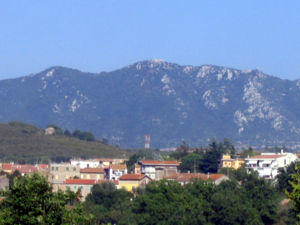
Horace’s Ode I:IX, Vides ut alta (translated by David West), was inspired by Mount Soracte (aka Soratte), in the Tiber Valley, north of Rome, and pictured here.  Carpe diem is the theme.

You see Soracte standing white and deep
with snow, the woods in trouble, hardly able
to carry their burden, and the rivers
halted by sharp ice.
Thaw out the cold. Pile up the logs
on the hearth and be more generous, Thaliarchus,
as you draw the four-year-old Sabine
from its two-eared cask.
Leave everything else to the gods. As soon as
they still the winds battling it out
on the boiling sea, the cypresses stop waving
and the old ash trees.
Don’t ask what will happen tomorrow.
Whatever day Fortune gives you, enter it
as profit, and don’t look down on love
and dancing while you’re still a lad,
while the gloomy grey keeps away from the green.
Now is the time for the Campus and the squares
and soft sighs at the time arranged
as darkness falls.
Now is the time for the lovely laugh from the secret corner
giving away the girl in her hiding-place,
and for the token snatched from her arm
or finger feebly resisting.

Reference:

Horace [1997 AD/23 BCE]: The Complete Odes and Epodes. Translation by David West. Oxford, UK: Oxford University Press.
Note: The opening of this poem was recited (in Latin) in May 1944 by German army officer and Military Governor of occupied Crete, General Heinrich Kreipe, while being transported following his kidnapping by the Cretan resistance during World War II.   Traveling with the resistance, British SOE agent Major Patrick Leigh Fermor recognized the ode, and completed the stanza to the surprise of Kreipe.   There is something indescribably sad about this story, a small incident revealing so much about Nazi destruction of Europe’s common culture.

Kaleidic moments

Is the economy like a pendulum, gradually oscillating around a fixed point until it reaches a static equilibrium?  This metaphor, borrowed from Newtonian physics, still dominates mainstream economic thinking and discussion.  Not all economists have agreed, not least because the mechanistic Newtonian viewpoint seems to allow no place for new information to arrive or for changes in subjective responses.   The 20th-century economists George Shackle and Ludwig Lachmann, for example, argued that a much more realistic metaphor for the modern economy is a kaleidoscope.  The economy is a “kaleidic society, interspersing its moments or intervals of order, assurance and beauty with sudden disintegration and a cascade into a new pattern.” (Shackle 1972, p.76).
The arrival of new information, or changes in the perceptions and actions of marketplace participants, or changes in their subjective beliefs and intentions, are the events which trigger these sudden disruptions and discontinuous realignments.   Recent events in the financial markets show we are in a kaleidic moment right now.  If there’s an invisible hand, it’s not holding a pendulum but busy shaking the kaleidoscope.
Reference:
Geoge L S Shackle [1972]: Epistemics and Economics.  Cambridge, UK:  Cambridge University Press.
 

A data architecture for spimes

Thinking some more about spimes, those product entities that exist individually in space and time. I can see they could lead to major changes in the way in which marketing data is collected, collated, stored, analyzed, and used.   Clearly, individual spimes and their wranglers will generate a lot of data as they interact with the world and report back (eg, via RFID and GPS), and that data could usefully form the basis for marketing knowledge and marketing action.   But the web changes everything.  Spime wranglers, being intelligent human beings and companies, could comment and reflect on their interactions; the social web allows them to meet each other, across space and across time, in the same way that a houseowner can “meet” the previous or future occupants of his house.    Likewise, intelligent spimes could also reflect on their interactions, and even wrangle less-intelligent spimes.
What software architecture is appropriate for this mass of data?   Clearly, we’d want to store all the data, regardless of its format, in databases.  My question is pitched at a higher level of abstraction than that of the databases.  We desire that multiple, independent agents (both people and devices) are able to access the data, to read it and contribute to it, and maybe to over-write it (assuming they have the appropriate authorizations).  Moreover, we want to be able to combine and reason-across the data generated by one spime, say a particular motor vehicle, with that of other spimes — say, other vehicles of the same model, or other vehicles owned by the same person, or other vehicles purchased in the same year, etc.   We’d also like to combine and reason-across the data generated by spimes in different product categories — all the durables purchased by the Smith family in their life, for instance, or all the products purchased in Main Street, Anytown, last week.
An obvious data architecture for multiple, independent reading- and writing-entities is a blackboard.  A blackboard architecture is a shared memory space which enables agents sending and receiving messages to be decoupled from one another, both spatially and temporally.   Exactly as a blackboard does, messages left on the blackboard are stored until they are erased, and so the long-dead can communicate to the living, who can in turn communicate to the not-yet-born.   Tuple spaces and the associated Linda language are an example of a blackboard architecture (implemented in Java as Java Spaces).  We could imagine that each spime has its own tuple space, partitioned into secure sub-spaces for different spime-wranglers, from manufacturers, through each spime owner or carer, to after-sales service providers and disposal agencies.  Access to spaces will need to be controlled, so that only authorized agents may write, read and erase data in their allocated partition.   Here we could use something called Law-Governed Linda, an enhancement of Linda designed to add security features, although this may be too rigid for products whose uses cannot be readily predicted in advance.   An architecture allowing access to a tuple space following an appropriate dialogue between the relevant agents may be more flexible.
So far, so good for the data storage and access.  But spimes and spime wranglers will generate enormous quantities of data, and analyzing all this data will require some effort.  Better then, to plan for this effort and automate as much of the data collation, aggregation, processing and analysis.   Here, I suggest we should use so-called Tuple Centres, which are intelligent Tuple Spaces, able to reason over the data they hold.  Because we will want to combine and analyze data arising from different spimes, these tuple centres will need to communicate with one another, and agree (or not) to allow their data to be aggregated. A multi-agent system (MAS) with agents representing each spime-space (ie, the tuple space of each spime), and, for many spimes, each partition of each spime-space, seems the most effective architecture.  This is because the interests of the relevant stakeholders (spime-wranglers, marketing departments, manufacturers and service providers, data protection agencies, the state, the law) will vary and a MAS is the most effective way to formally represent and accommodate these diverse interests in a software system.
There are many details still be worked for this architecture.  But even at this level, it is clear that the traditional marketing data warehouse architecture is not sophisticated enough for what is needed for spimes. Hence, my statement above that spimes could lead to major changes in the way in which marketing data is collected, collated, stored and analyzed.  Use of spime data I will leave for another post.
References:
TuCSon, developed at the University of Bologna, Italy, is a platform which enables fast implementation of tuple centre applications.

Social networking v1.0

Believers in the potential of Web 2.0, such as we at Vukutu, think it will change many things — our personal interactions, our way of being in the world, our social lives, our economic lives, even our sciences and technologies.   The basis of this belief is partly by comparison with what happened the first time social networking became fashionable in western society.   This occurred with the rise of the Coffee House in western Europe from the middle of the 17th century.
Coffee, first cultivated and drunk in the areas near the Red Sea, spread through the Ottoman empire during the 16th century.   In Western Europe, it became popular from the early 17th century, initially in Venice, becoming known to educated Europeans roughly simultaneously with marijuana and opium.  (An interesting question for marketers is why coffee became a popular consumer product in Europe and the others did not.)  Because of the presence there of scholars of the orient and scientists with an experimentalist ethos, coffee first arrived in the British Isles in Oxford, where it was consumed privately from at least 1637;  the first public coffee house in the British Isles opened in Oxford in 1650, called the Angel and operated by a Mr Jacob.  The first London coffeehouse was opened in 1652 by Pasqua Rosee; the same mid-century period saw the rise of public coffee houses in the cities of France and the Netherlands.  For non-marketers reading this, it is worth realizing that opening a coffee house meant first having access to a regular source of coffee beans, no mean feat when the only beans then grew in the Yemen and north-east Africa.

Facing competition, coffee houses soon segmented their market, and specialised in particular activities, types of conversation, or political positions (sound familiar,  bloggers?), and provided services such libraries, reading rooms, public lectures, scientific demonstrations and auctions. Educated people and businessmen would often visit several coffee houses each day on their rounds, to collect and trade information, to meet friends and colleagues, to commune with the like-minded, and to transact business.  The coffee houses were centres for learning and debate, just as blogs are today, as well as places of economic exchange.
What were the consequences of this new mode of human interaction?  Well, coffee houses enabled the launch of at least three new industries — insurance, fine-art auctions, and newspapers — and were the physical basis for modern stock exchanges.  For instance, English insurer Lloyds of London began in Edward Lloyd’s coffee house in 1688.  And these industries themselves enabled or facilitated others.  The development of an insurance industry, for example, both supported and grew alongside the trans-continental exploration undertaken by Dutch, English and Iberian merchant shipping fleets:  deciding whether to invest in  perilous oceanic voyages required some rigour in assessing likely costs and benefits if one wished to make a long-term living from it, and being able to partition, bundle, re-bundle and on-sell risks to others.
And coffee-houses even supported the development of a new science.  In the decade around 1665, the modern idea of mathematical probability arose, seemingly independently across western Europe, in what is now Britain, France, Italy, the Netherlands and Switzerland.   There is still some mystery as to why the mathematical representation of uncertainty became of interest to so many different people at around the same time, especially since their particular domains of application were diverse (shipping accidents, actuarial events, medical diagnosis, legal decisions, gambling games).  I wonder if sporadic outbreaks of the plague across Europe provoked a turn to randomness.  But there is no mystery as to where the topic of probability was discussed and how the ideas spread between different groups so quickly: coffee houses, and the inter-city and inter-national information networks they supported, were the medium.
What then will be the new industries and new sciences enabled by Web 2.0?
POSTSCRIPT: Several quotes from Cowan, for interest:

“No coffeehouse worth its name could refuse to supply its customers with a selection of newspapers.  . .  . The growing diversity of the press in the late seventeenth and early eighteenth centuries meant that there was great pressure for a coffeehouse to take in a number of journals.  Indeed, many felt the need to accept nearly anything Grub Street could put to press.  . . . Not all coffeehouses could afford to take in every paper published, of course, but many also supplied their customers with news published abroad.  Papers from Paris, Amsterdam, Leiden, Rotterdam, and Harlem were commonly delivered to many coffeehouses in early eighteenth-century London.  The Scotch Coffeehouse in Bartholomew Lane boasted regular updates from Flanders on the course of the war in the 1690s.   Along with newspapers, coffeehouses regularly purchased pamphlets and cheap prints for the use of their customers.” (pp. 173-174).

“Different coffeehouses also arose to cater to the socialization and business needs of various professional and economic groups in the metropolis. [London]  By the early decades of the eighteenth century, a number of separated coffeehouses around the Exchange had taken to catering to the business needs of merchants specializing in distinct trades, such as the New England, the Virginia, the Carolina, the Jamaica, and the East India coffeehouses.  Child’s Coffeehouse, located conveniently near the College of Physicians, was much favoured by physicians and clergymen.  Because such affiliations were well known, entry into one of these specialized coffeehouses offered an introduction into the professional society found therein.” (pp. 169-170).

“The numerous coffeehouses of the metropolis were greater than the sum of their parts; they formed an interactive system in which information was socialized and made sense of by the various constituencies of the city.   Although a rudimentary form of this sort of communication circuit existed in early modern England (and especially London) well before coffeehouses were introduced in places such as St. Paul’s walk or the booksellers’ shops of St. Paul’s churchyard, the new coffeehouses quickly established themselves at the heart of the metropolitan circuitry by merging news reading, text circulation, and oral communication all into one institution.  The coffeehouse was first and foremost the product of an increasingly complex urban and commercial society that required a means by which the flow of information might be properly channeled.” (p. 171)

 
References and Acknowledgments:
My thanks to Fernando E. Vega of the USDA for pointing me to the book by Cowan.
Brian Cowan [2005]:  The Social Life of Coffee:  The Emergence of the British Coffeehouse.  New Haven, CT, USA:  Yale University Press.
Ian Hacking [1975]:  The Emergence of Probability: a Philosophical Study of Early Ideas about Probability, Induction and Statistical Inference. London, UK: Cambridge University Press.
Fernando E. Vega [2008]: The rise of coffee.  American Scientist, 96 (2): 138-145, March-April 2008.

Friday Poem: Song

A long-standing tradition here which we are starting today is a Friday poem.   Mention earlier this week of the movie The Good Shepherd reminds me of the scene in which the Jim Angleton character (played by Matt Damon) discovers that his Yale Literature Professor Dr Fredericks (played by Michael Gambon) has plagiarized a poem.

The poem in question, Song, is by a real poet, Joseph Trumbull Stickney, and is about a cuckoo; this is very appropriate for a movie about spies and spying, since many species of cuckoo are brood parasites, laying their eggs in the nests of other birds.   Gambon’s character was at that point in the film pretending to be someone other than he really was. Angleton had studied poetry at Yale and co-founded a poetry magazine, Furioso, while a student.

Joe Stickney (1874-1904) was a student of George Santayana at Harvard and later friends with him and with Henry Adams in Paris, where Stickney received the first doctorate of letters from the Sorbonne given to an American.  Adams wrote of him: “[in Paris one could] totter about with Joe Stickney, talking Greek philosophy or recent poetry” (The Education, p. 1088) and, “Bay Lodge and Joe Stickney had given birth to the wholly new and original party of Conservative Christian Anarchists, to restore true poetry under the inspiration of the Gotterdammerung.” (The Education, p. 1090).

Stickney traveled in Europe and then taught Greek at Harvard, before dying suddenly of a brain tumour.  Stickney’s poetry has an elegaic, autumnal feel about it, a sense of loss; it is writing from the end of an era, rather than from the start of one, as is Pounds’ or Eliot’s.    Here is “Song“, written in 1902, and very appropriate for the season we in the northern hemisphere are now in:

A bud has burst on the upper bough
(The linnet sang in my heart today);
I know where the pale green grasses show
By a tiny runnel, off the way,
And the earth is wet.
(A cuckoo said in my brain: “Not yet.”)

I nabbed the fly in a briar rose
(The linnet to-day in my heart did sing);
Last night, my head tucked under my wing,
I dreamed of a green moon-moth that glows
Thro’ ferns of June.
(A cuckoo said in my brain: “So soon?”)

Good-bye, for the pretty leaves are down
(The linnet sang in my heart today);
The last gold bit of upland’s mown,
And most of summer has blown away
Thro’ the garden gate.
(A cuckoo said in my brain: “Too late.”)

POSTSCRIPT (added 2008-10-25): Since posting this, I have learnt about a recent setting to music of another elegaic Stickney poem, Mnemosyne, by the Russian-American violist Lev Zhurbin.  The song is performed here by Zhurbin’s eclectic gypsy-influenced group, Ljova and the Kontraband, and the poem itself is here.   The poem is about the decay of memories over time, and what I found most appealing about the setting is the final repetition of the central refrain, It’s autumn in the country I remember, a refrain which Stickney varies slightly each time it appears. (Thanks, JS).

POSTSCRIPT (added 2009-09-28): I wonder if Angleton met with Santayana in Rome when Angleton was engaged in espionage after WW II, using illegal bribery and much else besides to ensure (inter alia) that the Communist Party of Italy did not win the post-war elections.  They would probably have agreed on politics.  And, of course, Angleton, like Santayana, was a child of two cultures, American and Hispanic, since Angleton’s mother was Mexican.

POSTSCRIPT (added 2010-11-03):  I encounter something which suggests it would be more surprising for Angleton NOT to have met Santayana in Rome than otherwise.    From M. M. Kirkwood’s account of Santayana’s life and works [1961]:

So Santayana’s sympathy and gay human spirit remained unchanged.  He was responsive and generous always.  Not only [page-break] close friends like Daniel Cory, and distinguished creatures like the Marchesa Iris Origo, were warmly received in Santayana’s room with the Blue Sisters [in Rome].  Tom, Dick, and Harry were also welcomed, for of the numbers of American soldiers who were calling on him in 1945 he wrote in happy vein: “As to society, I have never received so many visits as the American soldiers in Rome have made me.  It has been very pleasant to see so many young faces and to autograph so many books, which is what they usually ask me to do.” [pp. 172-173] 

References:

Henry Adams [1907/1983]:  The Education of Henry Adams.  New York, NY, USA:  The Library of America.

M. M. Kirkwood [1961]: Santayana:  Saint of the Imagination.  Toronto, Canada:  University of Toronto Press.

Perceptions and counter-perceptions

The recent death of Yuri Nosenko allows me to continue an intelligence arc in these posts.  What is the connection to marketing, I hear you cry!  Well, marketing is about the organized creation and management of perceptions, which could also be a definition of secret intelligence activities.  In any case, the two disciplines have many overlaps, including some coincident goals and some similar methods, which I intend to explore on this blog.

First, let us focus on Nosenko.   He presented himself in Geneva in 1961 to CIA as an agent of KGB willing to spy for the Americans, and then defected to the USA in 1964.  Among other information, he came bearing a firm denial that the USSR had had anything to do with the assassination of John F. Kennedy in November 1963.   JFK’s alleged assassin, Lee Harvey Oswald, was, after all, one of the very few (perhaps under 1000) people who had defected from the USA to the USSR between 1945 and 1963, and one of the even fewer (perhaps under 50) people who had defected back again.  Nosenko claimed to have read Oswald’s KGB file.
From the start, lots of doubts arose regarding Nosenko’s testimony.   He did not seem to know his way around KGB headquarters, his testimony contradicted other information which CIA knew, there were  internal inconsistencies in his story, and he cast serious aspersions on an earlier defector from KGB to CIA, claiming him to be a KGB plant.   Was Nosenko, then, a KGB plant or was he the genuine defector?   Within CIA the battle waged throughout the 1960s, with first the sceptics of Nosenko and then subsequently the believers in his bona fides holding sway.  Chief among the sceptics was James J. Angleton, who came to see conspiracies everywhere, and who was eventually fired from CIA for his paranoia.   (Robert De Niro’s film “The Good Shepherd”  is based on the life of Angleton, with Matt Damon taking this part, and features a character based on Nosenko.)  Finally, CIA decided officially to believe Nosenko, and he was placed in a protection programme.  He was even asked to give lectures to new CIA recruits on the practices of KGB, such was his apparent acceptance by the organization.
This final position so angered one of the protagonists, Tennent Bagley, that, 40 years later, he has written a book arguing the case for Nosenko being a KGB plant who duped CIA.   The book is very compelling, and I find myself very much inclined to the sceptic case.   However, one last mirror is missing from Bagley’s hall.   What if the top-most levels of CIA really did doubt that Nosenko was genuine?    Would it not be better for CIA to not let KGB know this?  In other words, if your enemy tries to dupe you, and you realise that this is what they are trying to do, is it not generally better to let them think they have succeeded, if you can?    Certainly, more information (about their methods and plans, about their agents, about their knowledge) may potentially be gained from them if you manage to convince them that they have indeed duped you.  All you lose is – perhaps – some pride.  Pretending to be duped by Soviet intelligence is perhaps what Britain’s MI6 did regarding Kim Philby, Donald Maclean and Guy Burgess:  it is possible that MI6 knew many years before their defections that these men were working for the Soviets, and used them in that period as conduits for messages to Moscow.
In the case of Nosenko the dupe arrived bearing a message about the JFK assassination.   For many and various reasons (not all of them necessarily conspiratorial), CIA may have been keen to accept the proposition that KGB were not involved in JFK’s assassination.   How do you convince KGB that you believe this particular message if you don’t believe the messenger is genuine?   So, also for pragmatic reasons, the top levels of CIA may have decided to act in a way which would lead (they hoped) to KGB thinking that the KGB’s ruse had worked.
How then to convince KGB that their plant, Nosenko, was believed by CIA to be for real?  Simply accepting him as such would be too obvious – even KGB would know that his story had holes and would not believe that a quick acceptance by CIA was genuine.   Better, rather, for CIA to argue internally, at length and in detail, back-and-forth-and-forth-and-back, about the question, and then, finally, in great pain and after much disruption, decide to believe in the defector.   Bagley either does not understand this last mirror (something I sincerely doubt, since his book evidences a fine mind and very keen understanding of perception management), or else perhaps his book is itself part of a plan to convince KGB that Nosenko was fully believed by CIA.
 
References:
Tennent H. Bagley [2007]: Spy Wars: Moles, Mysteries, and Deadly Games.  New Haven, CT: Yale University Press.
Robert De Niro, Director [2006]:  The Good Shepherd. Universal Pictures.
Tim Weiner [ 2007]:  Legacy of Ashes: The History of the CIA.  Doubleday.

A salute to Dick Bissell

For those who know his name, Richard Bissell (1910-1994) probably has a mostly negative reputation, as the chief planner of the failed attempted invasion of Cuba at the “Bay of Pigs” in April 1961.  Put aside the fact that last-minute changes to the invasion plans (including a change of location) were forced on Bissell and CIA by the Kennedy Administration; after all, as Bissell himself argued in his memoirs, he and CIA could have and should have done more to resist these changes.  (There is another post to be written on the lessons of this episode for the making of complex decisions, a topic on which surprisingly little seems to have been published.)  Bissell ended his career as VP for Marketing and Economic Planning at United Aircraft Corporation, a post he held for a decade, although he found it unfulfilling after the excitement of his Government service.

Earlier in his career, Bissell was several times an administrative and organizational hero, a man who got things done.  During World War II, Bissell, working for the US Government’s Shipping Adjustment Board, established a comprehensive card index of every ship in the US merchant marine to the point where he could predict, within an error of 5 percent, which ships would be at which ports unloading their cargoes when, and thus available for reloading.  He did this well before multi-agent systems or even Microsoft Excel. After WW II, he was the person who successfully implemented the Marshall Plan for the Economic Recovery of Europe.  And then, after joining CIA in 1954, he successfully created and led the project to design, build, equip and deploy a high-altitude spy-plane to observe America’s enemies, the U-2 spy plane.   Bissell also led the design, development and deployment of CIA’s Corona reconnaisance satellites, and appears to have played a key role in the development of America’s national space policy before that.
Whatever one thinks of the overall mission of CIA before 1989 (and I think there is a fairly compelling argument that CIA and KGB successfully and jointly kept the cold war from becoming a hot one), one can only but admire Bissell’s managerial competence, his ability to inspire others, his courage, and his verve.  Not only was the U-2 a completely new plane (designed and built by a team led by Kelly Johnson of Lockheed, using engines from Pratt & Whitney), flying at altitudes above any ever flown before, and using a new type of fuel (developed by Shell), but the plane also had to be equipped with sophisticated camera equipment, also newly invented and manufactured (by a team led by Edwin Land of Polaroid), producing developed film in industrial quantities.  All of these components, and the pilot, needed to operate under extreme conditions (eg, high-altitudes, long-duration flights, very sensitive flying parameters, vulnerability to enemy attack).  And the overall process, from weather prediction, through deployment of the plane and pilot to their launch site, all the way to the human analyses of the resulting acres of film, had to be designed, organized, integrated and managed.
All this was done in great secrecy and very rapidly, with multiple public-sector and private-sector stakeholders involved.   Bissell achieved all this while retaining the utmost loyalty and respect from those who worked for him and with him.  I can only respond with enormous admiration for the project management and expectations management abilities, and the political, negotiation, socialization, and consensus-forging skills, that Dick Bissell must have had.  Despite what many in academia believe, these abilities are rare and intellectually-demanding, and far too few people in any organization have them.
References:
Richard M. Bissell [1996]:  Reflections of a Cold Warrior:  From Yalta to the Bay of Pigs. New Haven, CT, USA:  Yale University Press.
Norman Polnar [2001]:  Spyplane:  The U-2 History Declassified.  Osceola, WI, USA: MBI Publishing.
Evan Thomas [1995]:  The Very Best Men.  Four Who Dared:  The Early Years of the CIA.  New York City, NY, USA:  Touchstone.